I want to share this footage of my gig with Filipino progressive rock band fuseboxx last February 2014 in Baguio City, Philippines. Ulanarao is one of the songs from fuseboxx's first album. The song is pretty much a heavy prog-rock tune with straight-ahead 4/4 grooves, tribal tom patterns, double bass drum parts, and some odd-time twists (7).
My drum set-up on this gig: 5x13" Tama Artwood Maple snare drum, Tama Superstar drums, Tama Speed Cobra double bass pedal, Zildjian cymbals. I wish I had more toms and cymbals. =D
Fuseboxx (2014):
Abby Clutario - vocals, keys, Chapman stick
Eric Tubon - keys
Mico Ong - guitar
Anthony Dio - drums
Follow fuseboxx on Facebook, YouTube, Spotify, and Instagram.
Showing posts with label Tama. Show all posts
Showing posts with label Tama. Show all posts
November 16, 2015


June 26, 2012
Mike Alba's Muscle Memory Workout Program (Module 2)
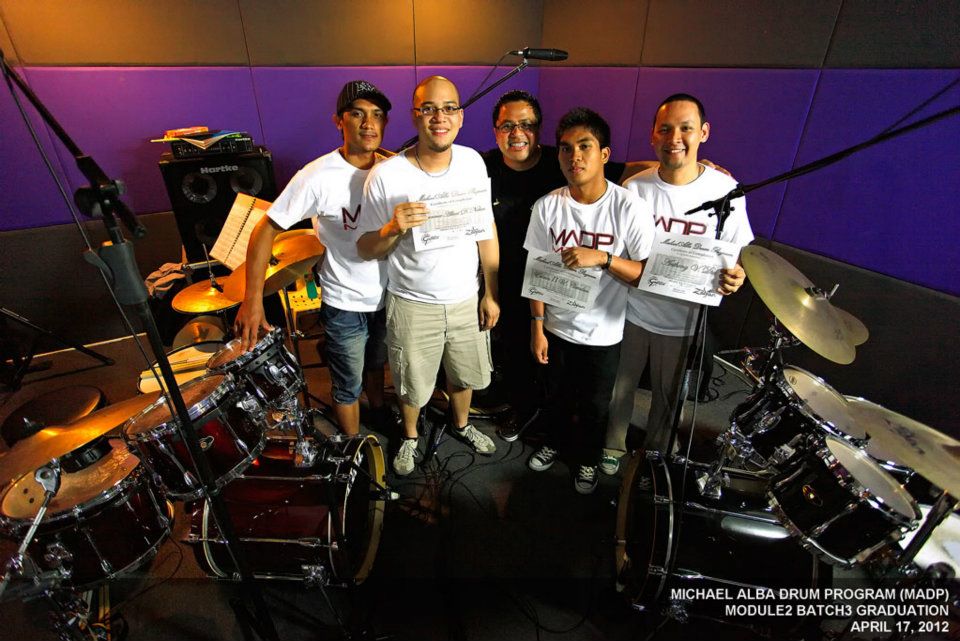 |
| MADP Module 2, Batch 3: From left-right: Weng Saavedra, Lawrence Alba, Master Michael Alba, Ed Catalan, and Anthony Dio |
A couple of months ago, I just finished the Module 2 Program, which took every drumming and musical aspect notches higher and further challenged our drumming, in terms of technique, performance & creativity. The way I see it, Module 2 is a super-sized version of Module 1, which pushed me and my peers to our limits. In no particular order...

Module 2 simulates real-life career situations, and it pushed me to manage my time and practice habits. Every Module 2 homework consists of at least 3 challenging play-along tracks and a couple of creativity exercises which challenged us to create our own original parts. So it was also an exercise on time management, as we juggled our woodshedding hours with our nightly gigs, day jobs, school, quality time with loved ones, and whatever routine or schedule we're going through our everyday lives. And with how Sir Mike gave out our assignments, he's like a musical director handing out the pieces we needed to play, and we only had a few days to nail down everything! So it was like a real-life session scene, where we're expected to be on top of our game, learn new materials fast and effectively, and be able to come out with drum parts which will work for the music.
Module 2 pushed me to work harder on my sight reading. For me, the Module 2 Applied Sight Reading (ASR) Exercises are like Module 1 ASR Exercises, but on steroids! With its various mixes of notes, rests, and figures (in particular, plenty of triplets, sixteenths and thirty-second notes, and don't forget the infamous fermata), these are guaranteed to be incredibly challenging, even for drummers who are already used to sight reading. But once mastered, or at least be able to go through it, it will greatly help with our sight reading skills, plus our speed, endurance, articulation, and dynamics. Well, I'm still not the fastest sight reader, but thanks to the Module 2 ASR exercises (plus the more challenging play-along charts), my reading skills improved.

Module 2 pushed me to further respect and appreciate the drumming gods. It's not that I do not revere the likes of Jeff Porcaro, Steve Gadd, Dave Weckl, John Robinson, David Garibaldi, Will Kennedy, Vinnie Colaiuta, and all these amazing drummers (I love and worship them all!). In Module 2, we learned how to play their classic drum parts correctly and with conviction. So our respect, admiration, and fascination for these legends grew deeper.
Module 2 pushed me to become more creative. With the thousands of amazing drum licks and chops already invented and played over the years, are we still capable of creating a new, original drum part? The answer is YES, and Sir Mike's system made our creative juices flow, as we orchestrated our original fill-ins during the Module 2 sessions. Plus, whether we love soloing or not (I don't consider myself a good drum soloist, and I often dread playing drum solos), there were several activities in Module 2 which challenged us to perform effective drum solos, which should still be a musical statement instead of just scattered pieces of notes, chops, and licks.
 I
can go on and talk more about Module 2. But of course, I don't want to
give away too much information (for the sake of future Module 2
students). The bottom line is, Module 2 is big boy stuff.
It will push you hard. It will challenge you. It will inspire you.
And it can even frustrate you (in a constructive way). But at the end
of the day, as long as you persevere, remain patient, and work hard on
practicing and honing your craft, going through Module 2 is a very
rewarding experience.
Thank you very much Michael Alba for being a wonderful and inspiring mentor. You did it again, Sir Mike! You are a blessing to me and my peers. Thank you for your passion, generosity and positive spirit. To my Module 2 Batch 3 classmates - Lawrence Nolan, Weng Saavedra, and Ed Catalan: It was an amazing Module 2 adventure with you guys. Thanks for the friendship and support! To Doc Jigs Asinas, Module 2 Batch 3 misses you! To Kent Pedraja of KNR Studio in Cubao, Quezon City, thank you very much for the excellent venue for our graduation day and drumshed session! To fellow Mike Alba Drum Program graduates Ruben Tecson, Christian Enriquez, Nigel Norris, and Otep Conception, thank you very much for all the help, brotherhood, enthusiasm and laughter during our Module 2 Graduation Day!
Best wishes to all our drumming and musical endeavors! God bless Mike Alba Drum Program!
 |
October 9, 2010
The Simon Phillips Influence
As documented on my recent blog entry, with my purchase of a second-hand yet still good set of DW double pedals, I just returned to double bass drumming. Currently, I am in the slow and steady process of re-learning double bass, working more on my footwork strength and technique. As far as my personal style and preferences are concerned, I don't think I'll ever reach the extreme double bass skills of today's technique and speed demons such as Virgil Donati and Derek Roddy. And with my band's style of music, I cannot utilize double bass all the time, as much as how dominant double bass drummers like Mike Portnoy, Charlie Benante, and Vinnie Paul did with their respective bands and recordings. I guess I'm grooming myself more into a tasteful, musical, and occasional double bass drummer, opting to play double bass when it's called for in the music.
And speaking of tasteful and musical, my double bass studies have brought me back to one of my favorite drummers, a significant innovator in the art of double bass drumming, and among the best rock drummers of all time... Simon Phillips.
I always thought of emulating Simon Phillips' drumming style, which I like so much. It's also interesting to notice such diversity in his skills set. Simon is often described as the consummate rock drummer. Yet he is so well-rounded, for he can convincingly play different styles, such as pop, fusion, and jazz. Simon's drumming style may be technique-oriented. Yet he's also groovy and fluid. His drumming feels oh-so-good.
Simon's been playing on the same signature double bass, multi-tom, open-handed Tama drumkit set-up in the last 30 years or so. Though people who are not familiar of Simon's drumming may have the impression of an overplaying basher on a monster drumkit, it's actually the other way around. Simon is no hard hitter (to the point of breaking stuff). He treats his huge drumkit as one powerful musical instrument, meticulously creating musical drum parts with every tom, octoban, and gong bass. Simon's also got excellent ears for great drum sounds, which seem to be a mix of the more focused fusion drum sounds & the bigger-than-life rock drum sounds (which I also like). And of course, I mentioned his wonderful double bass technique. Take note too of his open-handed playing style, his knack for composition, & his ability to create very cool drum licks and fills.
Embedded below are three video excerpts coming from his instructional videos in the 90's. The instrumental performances also feature guitarist Ray Russell & bassist Anthony Jackson. The three examples below best represent what Simon Phillips is all about. Power, finesse, groove, feel, technique, style, creativity, musicality, great drum sounds, cool drum parts... I would love to emulate Simon Phillips' style.
Well, except for those old-school tights. I'll never wear one.
My Simon Phillips blogs from the past:
Toto, Live in Manila '08: My Concert Hangover, 04 April, 2008.
Zildjian Day Manila 2005: Simon Phillips Drum Clinic, 31 October, 2005.
September 24, 2010
Gearhead Thoughts: Back to Double Bass, and My Studio H Experience
 I have just survived playing without a double bass pedal for almost a year. October last year, I decided to take a vacation on double bass and return to single bass drumming, as documented in this October 2009 blog. Now, I am happy to say that I'm back to playing double bass.
I got myself a second-hand DW 5002AH Delta 2 double bass pedal two weeks ago. I bought it from a friend, and I think I'm the third or fourth owner of this pedal. It's an old model, but it's still in great mechanical condition. I just needed to clean it up a bit after I got it. I made some research on this particular model, and I reckon that this particular DW model was built circa 2002, judging from the footboards with the words "chain drive" casted above the distinct 5000 trademark. This model must be the first to have DW's Delta ball bearing hinges, with its distinct red finish. Plus, this model was the first to be featured with optional accessories such as pedal weights and stacking Elevator heels. The DWs I got have the weights, which are those round things screwed at the top end of the footboards.
Back in the day, when I was still starting out, DW's 5000 line of pedals were the most sought-after drum pedals, and these were the benchmark and cutting edge in terms of design, technology, and playability. In fact, they were my dream pedals. Until, the Japanese came out with their Iron Cobras (Tama) and Powershifter Eliminators (Pearl), which offer plenty of high tech features and player customization. Then, American pedal manufacturers such as Axis and Trick took pedal innovations notches higher. Nowadays, there are so many great drum pedals to choose from, and I guess we somehow owe it all to DW. As far as I'm concerned, the DW 5000 pedals are the pioneers of the modern bass drum pedal.
It's cool that I now have a DW 5002 double pedal. Though second-hand, I can still say that I'm able to get my dream pedal. Though it doesn't offer as much customization as the Cobras and Elims which I used to have, the DW still has that great feel, which is what matters the most. I don't know if it comes with maturity, but I'm probably getting less techy when it comes to pedals. I would still love to have a high-tech set of pedals someday, once it's time for me to upgrade. But for now, I'm enjoying these good old 5000's, which still feels great even with all its mileage and battle scars. And now, I have to shed off some of my double bass rust. Better get my footwork back on track.
***
 It's great timing that I got back to double bass. Recently, I was called to do this recording session. We recorded an original progressive rock composition, so it was an opportunity for me to go back to my rock roots and play some double bass.
It's a privilege for me to do a recording session at Hit Productions' Studio H last Sunday afternoon. It was my first time to do a session there, and it was a treat for me. Hit Productions is among the best audio production houses in the country, and their flagship Studio H reflects their quality, innovation, and their knack for the latest technology. For me, Studio H is like the 19 East of local recording studios. The studio is so well-equipped. The house kit is a Mapex Saturn, which sounded sweet. They have a stable of over a dozen snare drums of different shells and sizes, some of it are custom-made models from companies which I never get to read about in my drum magazines. Plus they have a wide selection of cymbals. I am particularly impressed with the set of Paiste Twenty cymbals, which I was able to try for the first time. If I were to use Paistes, the Twenty would be my line of cymbals. However, for the recording, I need brighter, heavier cymbals. Plus, they have enough drum hardware for drummers who need to improvise with their set-ups.
Studio H also has a baby grand piano, and plenty of high-tech recording tools and gadgets. The recording facility is also a haven for guitar and bass players, for there's an impressive collection of electric and acoustic guitars & bass guitars lined up along the walls of the mixing room. It's simply topnotch, and by far it's the most impressive recording studio I've ever visited.
Going back to the recording session, one of the bosses from Hit has this original progressive rock composition. For me, the song's got an old-school feel in it, with a twist of Frank Zappa & Black Sabbath. The song is funny. It is about this fictional superhero, who will be revealed as a homosexual later in the middle of the tune. There's some straight-ahead parts in 4/4, then the tricky odd-time pre-chorus, which I counted out was in 19/8. It was a challenging session for me because first, it's been a long time since I last played heavy progressive rock music. Second, I have to learn the song on the fly (while the people I worked with already knew the song). And third, I am recording with complete strangers! It sure took me some time to learn the track on the spot, particularly the transitions and the different grooves. Yet, at the end of the day, I thought it's a great challenge for me, and I hope that I'm able to satisfy the songwriter & my fellow sessionists. Though I wish I had more time, I think I could have done a much better job.
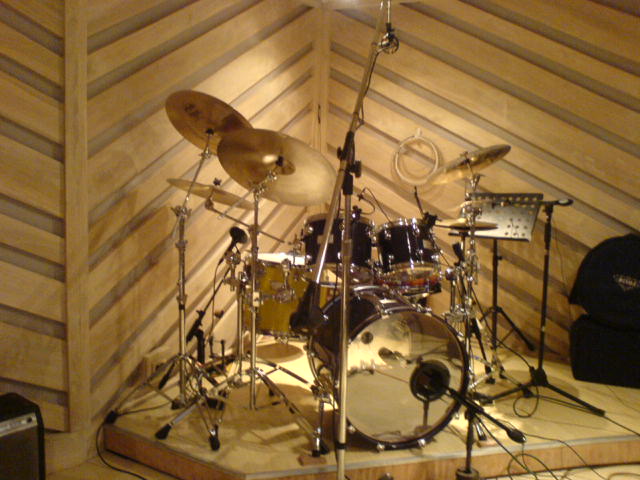 For that session, I set up the Mapex house kit with 3 toms (10"-12"-14"). My cymbals were a mix of Zildjians, Sabians & Paistes. My ride cymbal was a 22" Sabian Neil Peart Paragon Ride, which sounded big yet crisp. My effects cymbals were a Paiste Twenty splash & China, which sounded well on the mix. The hats and the crashes were all Zildjian. I also used my Old Faithful 14" Tama Starclassic Maple snare drum. No disrespect meant to Studio H's snare drum collection, but I thought of using my own drum so that I can hear how it sounds on recording. And finally, I hooked in my DW 5000 double bass pedal, which I got to use on a few fills & some straight-ahead passages.
I hope to have another opportunity to work again at Studio H. I had a blast.
September 14, 2010
My Sentiments on Mike Portnoy (and his Dream Theater departure)

--- Mike Portnoy, via Twitter/Facebook, 09 September 2010, 8:23am (Manila time)
I am one of the millions of Dream Theater fans from all over the world who are in a current state of shock and sadness, all because of the surprising departure of their drummer & one of the founding members, the mighty Mike Portnoy.
We know how busy the band is all these years, and each individual member having their respective side projects. But no other DT member is more workaholic than Mike, who mentioned in his 2007 instructional DVD In Constant Motion...
"My job has gone way beyond the drumset. In fact, when I'm playing drums, it's just a small fraction of what I do in the band. I'm one of the co-songwriters and arrangers, I'm one of the lyricists in the band, I produce the CDs, I direct the DVDs, I design the merchandise, I design the artwork and the album layouts... writing the set lists live, overseeing the websites and the fan clubs... It's just a constant 24/7 job..."
And these are only with Dream Theater. Don't forget the many other things Mike do on the side, such as project bands, tribute bands, drum clinics, and sessions with other musicians and groups.
 I understand Mike's feelings on how his routine with DT has become, well, a routine. It's indeed a cycle of songwriting, recording & touring over the years. If I were Mike, all that would definitely burn me out, regardless of how I love or how passionate I am with my work. Perhaps Mike wants to slow down a bit and enjoy some of the fruits of his labor. Mike is human too, and the guy deserves a break. Plus I totally understand the physical aspects of drumming, especially with the more athletic nature of playing heavy rock music plus the mental challenges of playing progressive music. Drummers need a break too. A drummer of Mike Portnoy's stature truly deserves it.
How I wish Mike was given consideration by his DT bandmates. At least a year of time out won't hurt the superband. But, 4 out of 5 DT members prefer to keep working, and they don't share the same sentiments as Mike. And the latter was forced to do something unimaginable. Now that the damage's been made, the world of Dream Theater and the drumming community are going nuts.
I firmly believe that great drummers are the foundation of great bands. Though there are many great bands out there who had a number of drummers in its lifetime, it may never be the same without the one drummer who played a significant role and casted a huge imprint on his/her respective group. The Who and Led Zeppelin were never the same again after Keith Moon and John Bonham passed away. Toto survived with the great help of Simon Phillips, but arguably it wasn't the same old Toto when Jeff Porcaro passed away in 1992. And imagine how life and music would be if Metallica no longer has Lars Ulrich. Or if Motley Crue doesn't have Tommy Lee. Or if Neil Peart never played again with Rush (thank God Neil returned after his sudden hiatus over a decade ago).
Dream Theater without Mike Portnoy. It's simply unimaginable.
In the meantime, I'll just see what will happen. DT will go on, make a new album in 2011, and tour. While Mike may never run out of things to do and music to play drums on, the idea of him no longer associated with DT may never sink in on me. Yet in my heart, there's a flicker of hope that one day, Mike and DT will be together again.

***
I first heard or read about Mike Portnoy back in 1993. I was a high school sophomore when I got this August 1993 issue of Modern Drummer which featured Mike Portnoy for the first time. One day, I was at a record bar in Robinsons Galleria (a mall which was near my school) when I first saw a cassette tape of Dream Theater's breakthrough album Images And Words. Yes, it was a cassette tape, and that was the first DT album that I've ever bought. I don't have that tape anymore, but I acquired the CD years later.
One of my bandmates back in high school, Jappy Columna, were among those friends of mine who first heard DT through me. He got so hooked, he brought home a DT Images And Words - Live in Tokyo concert video from his US trip during one summer vacation. He was also able to find DT's 1989 debut album, When Dream and Day Unite. Plus, he got me a Live At The Marquee CD, which I still have up to this day.

And off to the 21st century, more albums were created - Six Degrees of Inner Turbulence, Train Of Thought, Octavarium, Systematic Chaos, Black Clouds & Silver Linings, plus some live albums, compilations, and concert DVDs in between. The more recent albums are more reflective of DT's heavy metal roots. It's cool that they're still in touch with their "more is more" philosophy, and their music doesn't show signs of slowing down, which contradicts the infamous trend on progressive groups who tend to mellow as they age. And of course, Mike Portnoy's drumming has been stellar all these years. In fact, I think Mike's still getting better as he ages.
The big question among many fans is... Who will be filling in the Dream Theater drum throne? We have yet to find out who that guy will be, and he's going to have huge shoes to fill plus anticipated comparisons and expectations of gargantuan proportions. Sigh, I still can't imagine Dream Theater without Mike. And hey Mike, despite how I'm feeling, I totally respect your decision. Me & your legion of drumming fans here in the Philippines are still behind you.
 |
| Okay, who's filling in for Mike? |
*The top photo is Mike's current Twitter photo. The rest are from Drummerworld.com.
June 29, 2010
K24/7 Highlight: Music Update Live TV Guesting

Last night, K24/7 guested on ABS-CBN's Music Uplate Live, a late night music show that features Filipino artists. It was like a last minute thing for us, as our TV guesting for this show was confirmed just last weekend.
The show last night was hosted by two great Filipino artists - the multi-talented 6cyclemind drummer & Protein Shake frontman Tutti Caringal, and the lovely soul siren Nina.
Tutti mentioned that it was the first time that there was a full band setup in the show, compared to the acoustic setups which were the norm on previous shows. And because the show isn't accustomed (yet) to full band setups, I needed to bring out my drumkit. Thinking about some of the potential technical limitations, I decided to go for a minimalist drum set-up - a 20" kick, my Magic Drum 13" Tama Artwood snare, a 14" tom on my right, hi-hats on my left, and a ride cymbal over the kick drum. Later on I wished I brought the whole rig, after realizing that the sound system had enough drum mics for a full drumkit. Anyway, it's alright because at times it can be fun playing on a few drums and a couple of cymbals.
My kit was set up right in the middle of the studio set because of its bigger footprint, while all my bandmates were on the platform. For a change, I was in front of my bandmates. I prefer being at the back where I can see everyone, but I had no choice last night.
My bandmates played through direct boxes because there were no amps provided. E decided to use his acoustic guitar last night, which brought a more relaxed, organic, and unplugged vibe to our music. A Korg keyboard was provided for Ian.
For me, this was one of the most fun TV guestings we ever had so far. We were all having fun, playing music, jamming and chatting with fellow artists Tutti & Nina. We didn't notice that the show already went overtime, and how we wished that time didn't fly too fast. We hope that we can be guests again next time.
Thanks to Tutti, Nina, direk Martin, and the ABS-CBN/Music Uplate Live crew. Thanks to The Amazing Playground for the shirts and jackets we wore last night. And thanks to everyone who watched the show and appreciated our music! By this time, there should be some video uploads of the show last night. Just look it up on Facebook.

Ian playing on my set-up during soundcheck.

Fan favorite Paolo takes his turn on my kit while Ian checks the keys.

K24/7 rhythm section. D, E, Ian & Gian.
All photos posted were captured using Anthony Dio's camera phone.
April 22, 2010
Gear Review: Puresound Custom Wires

Yet, the most overlooked part of the snare drum is this set of wires underneath the drum where the instrument got its name. Yes, the snares! Snare wires are often ignored, yet it's one very important component in a snare drum sound. Back in the day, snare wires are pretty much generic. When your snare wires break down, there are plenty of generic, inexpensive replacement sets available in our local music store.
I've been using Puresound Customs on my Magic Drum 5"x13" Tama Artwood Maple snare drum since early last year. That workhorse drum had numerous modifications. It's been through different batter head changes, and I even replaced the throw-off mechanism. But the Puresound Custom wires were the biggest and most significant difference. I remember the day I beefed up the Magic Drum with the 13" 16-strand Puresound Customs. After mounting the Custom wires to the drum, then some tweaking and fine tuning, I just played, and played... And I kept playing! I was wearing a big smile the whole time. The Magic Drum was already a joy to play in the beginning; but with the Puresound Custom upgrade, it was like a rebirth for my trusty power piccolo. The overall quality of the drum's sound was leveled up notches higher. Snare sound was more crisp, more articulate, more sensitive, and more dynamic. Buzz roles and ghost notes are more defined and more effortless-sounding. And just like any other quality instrument, it easily responds to the player's touch. I also remember the Magic Drum's first gig with the Puresound wires. I got compliments that night from fellow drummers in the audience & even from my bandmates! (Note: You can backread this old blog of mine, where I documented my first experience with the Puresound Customs).

I wonder how the guys from Puresound figured it out. It is the design of the copper-plated clip? Is it the medium-gauged, evenly spaced, premium-grade steel alloy wires? Or is it a combination of these elements, plus some secret formula or special design from the Puresound designers and engineers that we've never heard of? Whatever it is, the Custom Series wires are working well and it's bringing wonders to those who have experienced it. Up to this day, I still wonder how a simple snare wire upgrade can make an already good-sounding drum sound even way better? I would like to compare a Puresound wire upgrade on a snare drum to a stock car being pimped and tricked out into a leaner and meaner machine.
I would love to think of the Puresound Custom snare wires as my snare drums' ultimate secret weapons (though it's no longer a secret). The Custom Series snare wires may be more expensive than most wires available in the market, but it's the best investment I've ever made for my snare drums. It's definitely worth it, and I highly recommend it to fellow drummers who wish to rejuvenate their snare drum sound.
You can order Puresound snare wires here in Manila, through Vinci Rodriguez of The Drum Shop.
March 4, 2010
New Era Drum Tracks
I want to look back at my recording sessions, and share some of my thoughts about my drum tracks in our New Era album.
I played drums on four tracks in our album - Sweetest Thing, Don't Ever Let Go, Your Smile, and Pangako.
 "My bandmates and I were in the studio, working on "Sweetest Thing", which is the last song we finished for our upcoming album. This is an original song written for us by our dear friend Mike Luis of Freestyle. Mike is a genius when it comes to songwriting, and the song is sooo good that it gave my bandmate Paolo quite a headache while he was working on it in his computer haha, figuring out some of the notes Mike used (because Mighty Mike wasn't able to chart the notes, I think). It's a groovy, bouncy, and catchy tune. Anyway, the vocal parts were recorded on Wednesday night. Earlier that day, we had a last-minute decision to have my drum parts recorded live. At first, we thought of programming the drum parts. But I thought that I should play the drum parts live. I like the song, I like Paolo's drum ideas for it, and I was determined to put my mark in that song. And so, we booked a recording date at Blue Door Studio in Quezon City (the same studio where I recorded my drum parts for 'Pangako'). I was scheduled the next evening."
"In the studio, I set up a small kit which I felt would fit the song just right. My drumming inspiration for this song is Ahmir "?uestlove" Thompson, drummer and producer of Philadelphia-based hip-hop band The Roots. I went for the less-is-more approach. For this track, I want my drums to sound crisp and tight, almost like a toy, but still "realistic" enough for listeners to say, 'Hey, those are live drums!' I used three drums - an 18"x 20" kick and a 14" tom, which are both from my Tama Superstar kit, and my 5.5"x10" Black Panther Premium Maple, my choice snare drum for this track. I set up a few Zildjian cymbals - a pair of 12" A Special Recording Hi-Hats and a 16" K Dark Thin Crash (the said cymbals belong to my drummer friend Marco Katigbak), and my 20" K Custom Medium Ride. I thought of using my 8" A Custom Splash, but I find it too bright-sounding for the song, so I decided to remove it on my studio set-up. Paolo thought of using flammed cross-sticks for the backbeats on some of the verses, which is why I had my 13" Tama Artwood Maple snare drum on standby for that purpose (since I won't be able to play cross-sticks on a 10" snare). But later on during the session, we decided not to play cross-sticks anymore. And so, it was the 10" Black Panther all the way."
--- excerpts from my October 29, 2008 blog
I am pretty much happy with the outcome of this track, as I was somehow able to estimate the sound and feel I envisioned for the song. We got the tight, snappy, toy-like sound out of the drums, plus the bouncy & playful feel. The 10" Black Panther snare was the star of the drum set-up I used in that track. I remember feeling quite loose during this session, so it enabled me to become more playful behind the kit. Yet, I was having that "?uestlove-ish", less-is-more vibe, and I was making sure that my parts would still serve the music right. The tricky part in this track is the bridge part, where the groove shifts to a tight 16th note feel, against the shuffle grooves played through the verses and choruses.
This is one fun song to play, and drummers who'll play to this song can go loose. I look forward to playing this tune live.

"I just recorded some of my drum tracks this week at SoundsRite Recording Studio in Makati, which is operated by drummer Boyet Aquino (who is best-known for his work with Francis M's band Hardware Syndrome). The studio has a good reputation for its high-end equipment and facility & quality recording results, and its clients include a good number of big names in the music biz. Though Boyet has an impressive collection of high-end drums, I still chose to use my Tama Superstar kit."
"On the Monday night session, I recorded Don't Ever Let Go, which was written by Paolo. This is quite a difficult track for me because of the crafty drum parts Paolo envisioned for the song. This was the old song which we recorded at Blue Door Studio a couple of years ago, but had some bad luck. I'm already through with that unfortunate experience, and I'm glad that I'm able to perform better in the studio this time, without any technical problems."
"I can't remember what I ate that time, or if the stars were aligned during those nights. But for some reason, I feel good with recording my drum tracks at SoundsRite."
"In the studio, I brought with me my Tama Superstar kit, which has birch shells (birch drums are tried and tested in recording/studio situations). My toms are fitted with clear Evans G2 batters. My 18"x20" kick drum is fitted with an Evans EMAD batter and an Evans EQ3 Resonant black front head (with 5" offset hole). Though my drums are pretty much set up for live situations, I was eager to hear how it performs in the recording studio. At first, the drums sounded big and boomy. After some tweaking, we were able to get decent tom sounds which responded well in the mix and complimented the songs. I should try coated batter heads next time for the toms, for a warmer sound. The kick drum's heads needed to be loosened and Boyet placed some cloth inside in order to kill some of the overtones (because of the EMAD head, I don't have any muffling inside my kick drum). We were able to get a decent, thuddy, low-end sound from the kick."
"Opting to play simpler drum parts in the recording compared to what I would normally play on a gig, I only used the 10" and 14" toms, though I had the 12" tom set aside, in case it's needed. I was also able to use my 5"x13" Tama Artwood Maple and 5.5"x10" Black Panther Maple snare drums. I tried my Old Faithful 5.5"x14" Tama Starclassic Maple, but the Magic Drum and the Cat sounded more fitting for the songs. I was also able to use my two broken Zildjian K Custom Dark crash cymbals. Even if they had those cracks and were de-modified, they still retain that K Custom magic in their sound. It still has that complex, trashy & sophisticated character, while the damages dried up its decay. I kept these old cymbals because I felt that they'll work well in the studio. And gladly, they did."
--- excerpts from my April 26, 2008 blog
Don't Ever Let Go has become a favorite among most of our loyal friends and following. The story behind the making of this song is interesting. First of all, Paolo wrote this love song based on one bandmate's past relationship experience (guess who). Second, during the first couple of drum recording sessions for this song back in '07, the computer at Blue Door Studio crashed - twice! And during that time, never did that incident happened in that studio, which pretty much has a decent track record. And it's so funny and coincidental that the two gear crashes happened during the sessions for this one song. There's really something about this song.
Finally, we were able to record the drum parts at SoundsRite studio in the summer of '08. I think the delays on the drum recordings in '07 were destined to happen. Because during the SoundsRite sessions, I was more confident, I was more prepared, and I had my then-brand new Tama Superstar kit prepared for recording.
I think I finished the recording in a couple of hours, which surprised me because I never thought I'll finish that soon, considering the sensitivity of the song and some of the more specific drum parts Paolo wanted. Those drum fills during the bridge and the last chorus? I can't remember the number of times I did retakes! I would have played the drum parts differently in this track. But this was Paolo's composition, so with him being the composer and producer, I have to respect that.
I said this to most of our friends, and I'll say it again... Don't Ever Let Go is the most challenging song that I've recorded in our album. And it's even more challenging to play it live. Believe me, it's not as easy as it sounds.
In this song, my main snare drum is my workhorse "Magic Drum" 5"x13" Tama Artwood Maple. Plus, I have once again proven my theory on broken K Customs in this recording session. Despite the defects, they sounded lovely in the studio.
 "I recorded Your Smile, which was a bit easier for me because of its groovier, more straight-ahead nature; yet we need to make sure that my parts feel and sound right for the songs."
--- excerpt from my April 26, 2008 blog
Many listeners would think that the drum parts in Your Smile are programmed. But no, the whole thing is 100% live recording. It might not sound obvious during the first half of the song, which is mostly straight-ahead cross-stick grooves. But once the snare drum comes in at the last chorus after the bridge, that would hint the use of real drums played by a real drummer. Listen to the dynamics of the snare drum backbeat. I was in my "drum machine" mode during this song's recording session, yet I still want it to feel like it's human. And I have to say, this is one of my favorite tracks in our album.
Two snare drums were set up for this track. The main snare is my "Old Faithful" 14" Tama Starclassic Maple. It has the die-cast hoops, so I played the cross-sticks on that drum. On the left side of the kit is the 10" Black Panther Maple, where I played the backbeats of the last chorus. In case you're wondering about the splash cymbal model I used for this track, it's a 12" Zildjian Extra Thin Splash, which my good friend Rommell Garcia lent to me.
 "Recording began at around 12am. I did a couple of practice takes then made adjustments such as fine tuning the drums, making sure that the drum sounds will fit nicely with the song. (Studio Assistant) Ian double-checked the microphone set-up and prepared a click track for me. Then we went on with the actual recording. I'm not aiming to finish quickly or become a one-take wonder. The most important thing for me is to serve the music by playing drum tracks which will compliment the song. But still, we need to be efficient and productive with our studio time."
"On my first take, I wasn't quite warmed up yet, and I was still absorbing the feel of the song, the drumkit, and the studio room. But I felt confident that I'll be able to do better takes as we progress. I think it was on my third or fourth take when I finally got in the zone. I was fully warmed up and my focus was on a high level at that point. I thought I made a couple of good takes. But we know the drum parts can still get better."
"Recording resumed at around 3am. I lost a bit of momentum, and my hands got cold because of the strong air conditioning. But good thing I regained focus, and I was able to do my best takes of the night. In order for me not to repeat the whole take, we just went back to the parts which needed refinement, such as cymbal crescendos and embellishments, some fill-ins, and some hits which will lock in with the bass guitar parts."
 "My drumkit for this session is a Premier Artist Birch kit, which belongs to my good friend Ernest Ramos. I used two toms - an 8"x10" rack tom and a 14"x14" floor tom. Both toms are fitted with Evans G1 Coated batter heads. The kick is a 16"x18". Don't let its small size fool you. It's the biggest-sounding 18" bass drum that I've ever heard. It has a solid low-end thump, which often surprises those who hear it. The kick is fitted with an Aquarian Super Kick I Clear batter head, which contributes to that huge sound. The front head doesn't have a hole for the mic. I don't want to make a hole because the kit isn't mine and I don't want to ruin the nice white Aquarian coated front head. So we removed the front head and put a pillow in it (Ernest didn't put any muffling on his kick). The snare drum I used is my Old Faithful 5.5"x14" Tama Starclassic Maple, which is fitted with an Evans G1 Coated batter head and an Evans Snare Side 300 resonant head."
"I used my Zildjian cymbals. My hi-hats are a pair of 14" K Custom Dark Hats and my ride is a 20" K Custom Medium Ride. The two crash cymbals used are my semi-retired damaged cymbals, which I both acquired from my friend Bennii Obana sometime last year. On my left side was my freshly-cracked 17" K Custom Dark Crash, which I recently retired from gigging. On my right side was my de-modified 18" K Custom Dark Crash which had so many hairline cracks when I acquired it, I had it cut after I wounded my finger. Even if these crashes are damaged, they still have that spirit in their sound. I thought that I'd just save these cymbals for studio work, where I think they'll sound well. And they did sound exceptional in the studio."
--- excerpts from my November 16, 2007 blog
My drumming inspiration on Pangako is Jeff Porcaro. This is a love song with a pop arrangement and mass appeal, and I can't think of any other musical inspiration better than Jeff Porcaro, who was not only a groovy pop rock drummer with a solid foundation. He was a master of great feel and sensitivity. He had the knack for playing drum parts which fits best for the music, in relation to its theme and emotions. What mattered to Jeff the most is how the listeners feel the music. I recorded my drum parts for Pangako with Jeff Porcaro in mind. In fact, I think some of the drum fills I used reflected his huge influence on me. May this be my humble tribute to one of my favorite drummers. May God bless Jeff Porcaro's soul.
To fellow drummers who are curious about the accent cymbal I used during the bridge/guitar solo part, that was the broken 18" Zildjian K Custom Dark Crash on the right side of the set-up, which was trimmed down because of multiple hairline cracks. It sounded like a trashy china/crash hybrid, and it sounded great on recording. So, before disposing those broken cast cymbals, think about it first. You'll never know how they'll sound like in the studio. You'll never know if it's magic.
***
Final thoughts...
The music on Dry Your Eyes and Pangarap Ko'y Ikaw were arranged, programmed, and recorded by Jay Durias of South Border. So, if the songs are coming from a musical master, I wouldn't dare touch it! But if Jay would ask me to record the drum parts, I would have done it.
That Side Of Me and Prelude To Ecstasy might have been more slamming if we were able to record live drums for it. But it's alright, because it turned out just fine. Playing it live during our gigs would be a different story...
Come Back... It's the most perfect drum recording... Because there are no drums on it! ;)
I'm planning to play more live drums on our next album, and I would love to do something more refreshing and out of the box. I'm looking forward to that.
I played drums on four tracks in our album - Sweetest Thing, Don't Ever Let Go, Your Smile, and Pangako.
Sweetest Thing

"In the studio, I set up a small kit which I felt would fit the song just right. My drumming inspiration for this song is Ahmir "?uestlove" Thompson, drummer and producer of Philadelphia-based hip-hop band The Roots. I went for the less-is-more approach. For this track, I want my drums to sound crisp and tight, almost like a toy, but still "realistic" enough for listeners to say, 'Hey, those are live drums!' I used three drums - an 18"x 20" kick and a 14" tom, which are both from my Tama Superstar kit, and my 5.5"x10" Black Panther Premium Maple, my choice snare drum for this track. I set up a few Zildjian cymbals - a pair of 12" A Special Recording Hi-Hats and a 16" K Dark Thin Crash (the said cymbals belong to my drummer friend Marco Katigbak), and my 20" K Custom Medium Ride. I thought of using my 8" A Custom Splash, but I find it too bright-sounding for the song, so I decided to remove it on my studio set-up. Paolo thought of using flammed cross-sticks for the backbeats on some of the verses, which is why I had my 13" Tama Artwood Maple snare drum on standby for that purpose (since I won't be able to play cross-sticks on a 10" snare). But later on during the session, we decided not to play cross-sticks anymore. And so, it was the 10" Black Panther all the way."
--- excerpts from my October 29, 2008 blog
I am pretty much happy with the outcome of this track, as I was somehow able to estimate the sound and feel I envisioned for the song. We got the tight, snappy, toy-like sound out of the drums, plus the bouncy & playful feel. The 10" Black Panther snare was the star of the drum set-up I used in that track. I remember feeling quite loose during this session, so it enabled me to become more playful behind the kit. Yet, I was having that "?uestlove-ish", less-is-more vibe, and I was making sure that my parts would still serve the music right. The tricky part in this track is the bridge part, where the groove shifts to a tight 16th note feel, against the shuffle grooves played through the verses and choruses.
This is one fun song to play, and drummers who'll play to this song can go loose. I look forward to playing this tune live.
Don't Ever Let Go

"I just recorded some of my drum tracks this week at SoundsRite Recording Studio in Makati, which is operated by drummer Boyet Aquino (who is best-known for his work with Francis M's band Hardware Syndrome). The studio has a good reputation for its high-end equipment and facility & quality recording results, and its clients include a good number of big names in the music biz. Though Boyet has an impressive collection of high-end drums, I still chose to use my Tama Superstar kit."
"On the Monday night session, I recorded Don't Ever Let Go, which was written by Paolo. This is quite a difficult track for me because of the crafty drum parts Paolo envisioned for the song. This was the old song which we recorded at Blue Door Studio a couple of years ago, but had some bad luck. I'm already through with that unfortunate experience, and I'm glad that I'm able to perform better in the studio this time, without any technical problems."
"I can't remember what I ate that time, or if the stars were aligned during those nights. But for some reason, I feel good with recording my drum tracks at SoundsRite."
"In the studio, I brought with me my Tama Superstar kit, which has birch shells (birch drums are tried and tested in recording/studio situations). My toms are fitted with clear Evans G2 batters. My 18"x20" kick drum is fitted with an Evans EMAD batter and an Evans EQ3 Resonant black front head (with 5" offset hole). Though my drums are pretty much set up for live situations, I was eager to hear how it performs in the recording studio. At first, the drums sounded big and boomy. After some tweaking, we were able to get decent tom sounds which responded well in the mix and complimented the songs. I should try coated batter heads next time for the toms, for a warmer sound. The kick drum's heads needed to be loosened and Boyet placed some cloth inside in order to kill some of the overtones (because of the EMAD head, I don't have any muffling inside my kick drum). We were able to get a decent, thuddy, low-end sound from the kick."
"Opting to play simpler drum parts in the recording compared to what I would normally play on a gig, I only used the 10" and 14" toms, though I had the 12" tom set aside, in case it's needed. I was also able to use my 5"x13" Tama Artwood Maple and 5.5"x10" Black Panther Maple snare drums. I tried my Old Faithful 5.5"x14" Tama Starclassic Maple, but the Magic Drum and the Cat sounded more fitting for the songs. I was also able to use my two broken Zildjian K Custom Dark crash cymbals. Even if they had those cracks and were de-modified, they still retain that K Custom magic in their sound. It still has that complex, trashy & sophisticated character, while the damages dried up its decay. I kept these old cymbals because I felt that they'll work well in the studio. And gladly, they did."
--- excerpts from my April 26, 2008 blog
Don't Ever Let Go has become a favorite among most of our loyal friends and following. The story behind the making of this song is interesting. First of all, Paolo wrote this love song based on one bandmate's past relationship experience (guess who). Second, during the first couple of drum recording sessions for this song back in '07, the computer at Blue Door Studio crashed - twice! And during that time, never did that incident happened in that studio, which pretty much has a decent track record. And it's so funny and coincidental that the two gear crashes happened during the sessions for this one song. There's really something about this song.
Finally, we were able to record the drum parts at SoundsRite studio in the summer of '08. I think the delays on the drum recordings in '07 were destined to happen. Because during the SoundsRite sessions, I was more confident, I was more prepared, and I had my then-brand new Tama Superstar kit prepared for recording.
I think I finished the recording in a couple of hours, which surprised me because I never thought I'll finish that soon, considering the sensitivity of the song and some of the more specific drum parts Paolo wanted. Those drum fills during the bridge and the last chorus? I can't remember the number of times I did retakes! I would have played the drum parts differently in this track. But this was Paolo's composition, so with him being the composer and producer, I have to respect that.
I said this to most of our friends, and I'll say it again... Don't Ever Let Go is the most challenging song that I've recorded in our album. And it's even more challenging to play it live. Believe me, it's not as easy as it sounds.
In this song, my main snare drum is my workhorse "Magic Drum" 5"x13" Tama Artwood Maple. Plus, I have once again proven my theory on broken K Customs in this recording session. Despite the defects, they sounded lovely in the studio.
Your Smile

--- excerpt from my April 26, 2008 blog
Many listeners would think that the drum parts in Your Smile are programmed. But no, the whole thing is 100% live recording. It might not sound obvious during the first half of the song, which is mostly straight-ahead cross-stick grooves. But once the snare drum comes in at the last chorus after the bridge, that would hint the use of real drums played by a real drummer. Listen to the dynamics of the snare drum backbeat. I was in my "drum machine" mode during this song's recording session, yet I still want it to feel like it's human. And I have to say, this is one of my favorite tracks in our album.
Two snare drums were set up for this track. The main snare is my "Old Faithful" 14" Tama Starclassic Maple. It has the die-cast hoops, so I played the cross-sticks on that drum. On the left side of the kit is the 10" Black Panther Maple, where I played the backbeats of the last chorus. In case you're wondering about the splash cymbal model I used for this track, it's a 12" Zildjian Extra Thin Splash, which my good friend Rommell Garcia lent to me.
Pangako

"On my first take, I wasn't quite warmed up yet, and I was still absorbing the feel of the song, the drumkit, and the studio room. But I felt confident that I'll be able to do better takes as we progress. I think it was on my third or fourth take when I finally got in the zone. I was fully warmed up and my focus was on a high level at that point. I thought I made a couple of good takes. But we know the drum parts can still get better."
"Recording resumed at around 3am. I lost a bit of momentum, and my hands got cold because of the strong air conditioning. But good thing I regained focus, and I was able to do my best takes of the night. In order for me not to repeat the whole take, we just went back to the parts which needed refinement, such as cymbal crescendos and embellishments, some fill-ins, and some hits which will lock in with the bass guitar parts."

"I used my Zildjian cymbals. My hi-hats are a pair of 14" K Custom Dark Hats and my ride is a 20" K Custom Medium Ride. The two crash cymbals used are my semi-retired damaged cymbals, which I both acquired from my friend Bennii Obana sometime last year. On my left side was my freshly-cracked 17" K Custom Dark Crash, which I recently retired from gigging. On my right side was my de-modified 18" K Custom Dark Crash which had so many hairline cracks when I acquired it, I had it cut after I wounded my finger. Even if these crashes are damaged, they still have that spirit in their sound. I thought that I'd just save these cymbals for studio work, where I think they'll sound well. And they did sound exceptional in the studio."
--- excerpts from my November 16, 2007 blog
My drumming inspiration on Pangako is Jeff Porcaro. This is a love song with a pop arrangement and mass appeal, and I can't think of any other musical inspiration better than Jeff Porcaro, who was not only a groovy pop rock drummer with a solid foundation. He was a master of great feel and sensitivity. He had the knack for playing drum parts which fits best for the music, in relation to its theme and emotions. What mattered to Jeff the most is how the listeners feel the music. I recorded my drum parts for Pangako with Jeff Porcaro in mind. In fact, I think some of the drum fills I used reflected his huge influence on me. May this be my humble tribute to one of my favorite drummers. May God bless Jeff Porcaro's soul.
To fellow drummers who are curious about the accent cymbal I used during the bridge/guitar solo part, that was the broken 18" Zildjian K Custom Dark Crash on the right side of the set-up, which was trimmed down because of multiple hairline cracks. It sounded like a trashy china/crash hybrid, and it sounded great on recording. So, before disposing those broken cast cymbals, think about it first. You'll never know how they'll sound like in the studio. You'll never know if it's magic.
***
Final thoughts...
The music on Dry Your Eyes and Pangarap Ko'y Ikaw were arranged, programmed, and recorded by Jay Durias of South Border. So, if the songs are coming from a musical master, I wouldn't dare touch it! But if Jay would ask me to record the drum parts, I would have done it.
That Side Of Me and Prelude To Ecstasy might have been more slamming if we were able to record live drums for it. But it's alright, because it turned out just fine. Playing it live during our gigs would be a different story...
Come Back... It's the most perfect drum recording... Because there are no drums on it! ;)
I'm planning to play more live drums on our next album, and I would love to do something more refreshing and out of the box. I'm looking forward to that.
October 26, 2009
Gearhead Thoughts: Back to Single Bass, For Now
Lately, I've been having mixed emotions about my recent decision. Last week, I sold my Tama Iron Cobra double bass pedal. So now, I'm officially back to single bass.
 I sold my double pedal out of necessity and because of artistic reasons. To be honest, finances are quite tougher right now, with my new studio room and all the bills. I need some added funds to pay for my quarterly insurance bill, and I'm glad the sale was able to help me out with that. Musically, I was thinking of going back to single bass for quite some time, in order to go back to basics and concentrate more on my right foot. This idea is now fulfilled.
I've been playing single bass for a week now, which is quite a challenge for me because I've been playing double bass for so long that I got so used to it. My right foot is doing more work right now, while my left foot seems wired for playing two pedals that I need to adjust. It's funny because there were times during our gigs when I was about to instinctively play a double bass lick, and my left foot would naturally respond by shifting from the hi-hat pedal going to the twin pedal's slave pedal, only to realize that, "Oops, no more double pedal!" It has become a challenge especially during K24/7 gigs, where I found ways to integrate double bass in our style of music.
I guess I have to agree with my bandmate Paolo when he told me that double bass has become my trademark. It's a pretty unique quality, considering the idea that double bass is unusual on most mainstream musical styles, which includes R&B and hip-hop. I'm not really a heavy, speed demon type of double bass player. I choose when to use it in our music. I also have this goal or artistic intention of applying double bass on popular music.
When fellow drummers and musicians ask why I play double bass with K24/7, I would ask back, "Why not?" Drumset drumming is a constantly developing modern art form; it's still evolving up to this very day. Why not integrate double bass drumming on R&B, hip-hop, pop, and most popular, groovier styles of music? I think it's an interesting idea. Some drummers, mainly the younger ones, would often think that double bass is about speed and is intended for rock, metal, and heavier styles. It saddens me whenever there are some immature, close-minded, know-it-all types who criticize me for having a double pedal with K24/7. I know I'm not an advanced-level double bass player, I know I need to improve further, and I intend to work harder on my double bass technique when I go back to double bass. Personally, double bass is not limited to certain musical styles. It's all up to our creativity, and we can only be limited by our imagination. Plus, all double bass drummers should keep in mind that the guy who began the art of double bass drumming was this jazz/big band drummer.
We should keep in mind that in today's very modern times, thinking out of the box can be a very fruitful and wonderful thing. For example, we now see modern progressive rock/metal drummers who choose to play on small set-ups, instead of the stereotypical gargantuan multi-tom monster set-up. We all have the freedom to choose.
I have a strong admiration for dominant double bass drummers such as Virgil Donati, Derek Roddy and Mike Portnoy. I do wish I can someday reach their level of footwork speed, precision, and power. Yet, I also have a great admiration for tasteful double bass drummers like Simon Phillips, Tim Alexander, Steve Smith, Vinnie Colaiuta, Steve Gadd... and the list goes on. They are the types who are not so heavy and uber-technical on double bass; yet, when they choose to use it, their executions are very musical. Having a double bass pedal doesn't mean that you have to play it all the time. It's like a pianist has 88 keys on his synth, and that doesn't mean that he/she needs to use all those notes in one song. We need to pick our drum parts wisely, tastefully, musically.
Anyway, going back to single bass... Like I said, my drumming-related reason for going back to single bass is because of my intention of going back to the basics. And this includes my right foot technique. I feel like I need to work more on my right foot. When I was starting out back in the 90's, I was pretty much on the right track. I was so into those single bass grunge drummers - Matt Cameron of Soundgarden, Dave Kruzen and Dave Abbruzzese of Pearl Jam, Sean Kinney of Alice In Chains... I also dug the drumming of Eric Kretz of Stone Temple Pilots and Chad Smith of the Red Hot Chili Peppers... And thanks to these guys, I went back in time to discover the excellence of the late great John Bonham of Led Zeppelin... Thank Heavens for Bonzo's mighty, lightning-quick right foot!
I was so determined with my bass drum foot back in the day. Until one day, my heavy metal bandmates back in high school persuaded me to learn double bass, so that we can play some Metallica and Pantera tunes. At first, I wasn't so fond with the idea. Then after one jam session, they lent me a double bass pedal so that I can start practicing with it. From that moment on, and by the time I discovered the great progressive rock drummers, I got hooked with it.
Now I'm bringing back my enthusiasm for single bass. I've been playing single bass on church services in the last three years. The songs we play do not require double bass drumming. I once brought my double pedal at a church service, but I never really got to use it. I think I was only able to use it for a climactic ending for one fast song haha! Realizing that, I know that I'll just be fine without a double pedal with K24/7. It's just that, I got so used to playing double bass with my band. I find myself adjusting some of my drum parts. I'm missing double bass. I miss playing those "quad" fill-ins, those straight-ahead singles, those crazy song endings... I miss sneaking those double kick licks on songs like Icebox, Four Seasons of Loneliness, and our old-school MJ-EWF Medley.
I know I'll be going back to double bass sooner or later, and hopefully be able to score a better set of twin pedals. In the meantime, I'm rocking and grooving on a single bass pedal. I'm going to buy a nice single pedal soon...
September 5, 2009
Tama Starphonic Snare Drums... *wow!*
Most of my drummer buddies are aware of how much of a gearhead I can be when it comes to drum stuff. I love well-designed, well-crafted, and innovative drum equipment.
Now here's another new snare drum line which has caught my fancy... The new Tama Starphonic snare drums.
I think Tama's designers and engineers have once again raised the bar. They have created some new elements in snare drum design. It has everything that you would hope for in an ideal snare drum - great looks, great sound, and excellent quality; with the addition of some "noteworthy advancements" (quoted from Tama's marketing campaign on this new line). The Starphonic has several new key features, such as the Freedom Lugs and Claw Hooks (which allows a faster and more clutter-free drumhead replacement), the Grooved Hoops (no holes; instead, these hoops have this groove/channel that holds the Freedom Claw Hooks, and has a special profile design inspired by "stick-saver hoops"), and the new Linear Drive strainer and detachable butt plate. Very smart design.
The Tama Starphonic is also now in my snare drum wish list. Bravo!!
August 20, 2009
Music Review: Dream Theater - Black Clouds & Silver Linings

The album artwork, which was created by renowned graphic artist Hugh Syme (who made memorable album art for notable bands such as Rush, Queensrÿche, and Megadeth) is impressive, as expected from any Dream Theater production.
Black Clouds & Silver Linings features six new tracks; four tracks are in the 12-to-19-minute range, and the shortest track is about five and a half minutes. There are several box sets and packages available for the die-hard DT fan and memorabilia collector. The 3-cd Limited Edition Set includes a second disc that features 6 covers, and a third cd that features instrumental mixes of the new materials. In this review, I would focus on the main/standard cd.
On a drummer's perspective, Mike Portnoy's performance on the new album is what most Portnoy disciples and fanatics would expect from the 2004 Modern Drummer Hall of Famer - the usual Portnoy licks, grooves, polyrhythms, dominant double bass footwork, and unison playing with bandmates, plus his uncanny ability to play for the song in spite of the technical, over-the-top, "more is more" nature of Dream Theater's music. His drumming seems to become more aggressive with age, with no signs of mellowing nor slowing down. Portnoy is burning in this album!
The tracks that blew me away the most are A Nightmare To Remember (Track 1, 16:10), The Best Of Times (Track 5, 13:07), and The Count Of Tuscany (Track 6, 19:16).
Portnoy's thrash-inspired double kick grooves are the major drumming highlights of the opening track A Nightmare To Remember, a song about guitarist and co-producer John Petrucci's childhood car accident experience. His aggressive double bass attacks are like an unstoppable train, shifting from straight-ahead triplets to sixteenths to sextuplets, and back. Plus, watch out for the round of blast beats near the end of the tune for the win! Despite all that heavy drumming, my most favorite part of the song is the scene change at the 4:56 mark, which I thought was appropriately done. The changes in mood and dynamics fit the story and emotions being told in the song.
The Best Of Times is written by Portnoy in memory of his father Howard Portnoy, who passed away early this year. Obviously, this is a heartfelt and very personal song, which the drummer presented to his father before the latter's death. I can sense that Portnoy's personality and emotions are well-reflected in this piece. The track opens with a melancholic piano and violin section, then a guitar riff at the 2:46 mark signals the rocking 7/4 entry, which has this old-school-prog feel that reminds me of early 80's Rush works such as Red Barchetta.
The Count Of Tuscany has the most interesting instrumental intro I've ever heard from Dream Theater in the longest time. Dream Theater seems to be leaning more on their shred-heavy, thrash/metal side in the last few albums, so it's quite refreshing for me to hear an opening part which represents more of Dream Theater's progressive rock side. I notice several old-school progressive rock influences in this track, mostly from the school of Rush. It's also interesting to note that this song is about an actual encounter Petrucci had in Tuscany.
As for the other tracks... Dream Theater is in their "Metallica mode" on A Rite To Passage (Track 2, 8:35), the album's carrier single. Wither (Track 3, 5:25), a Petrucci song about writer's block, is the shortest track on the album, and has the simplest musical arrangement (based on Dream Theater standards). Portnoy just lays it down and adds just enough embellishments. The Shattered Fortress (Track 4, 12:49) completes Portnoy's Twelve-Step Suite, and is one of the heaviest tracks on the album.
Overall, I am digging Black Clouds & Silver Linings. It's the archetypal Dream Theater album; a balance of old-school progressive and heavy metal/thrash influences. This is a strong effort from the progressive metal supergroup, and probably one of their best studio works. Plus, it is testament to Mike Portnoy's pursuit to defy age and his status of being the current flagbearer of progressive metal drumming. This album is steadily rising to become one of my personal favorite Dream Theater albums.
*****
Special thanks to my sister Karen Dio for getting me a copy of this album, which she bought from her recent Singapore trip.
January 3, 2009
My Drumkit Set-Up Experiment, Part 2
Okay, so here's my drumkit set-up at our Off The Grill gig last night.

Added to my alternative set-up (as discussed a few days ago on this blog) is a Wuhan China cymbal on the right side, which is mounted on the same cymbal stand where my two low toms are suspended. I used the boom stand from OTG's house kit for my ride cymbal.
So, after the gig, I'm able to assess this set-up's pros and cons. I'll start with the cons...
CONS:
PROS:
SOLUTIONS AND APPLICATIONS:
Okay, that's it for now. Comments and suggestions are welcome.


Added to my alternative set-up (as discussed a few days ago on this blog) is a Wuhan China cymbal on the right side, which is mounted on the same cymbal stand where my two low toms are suspended. I used the boom stand from OTG's house kit for my ride cymbal.
So, after the gig, I'm able to assess this set-up's pros and cons. I'll start with the cons...
CONS:
- This set-up has a bigger footprint, which can be a concern on tight spaces and small stages.
- I'm still pretty much used to my kit's more compact original set-up. On the old set-up, tom fills were easy because all the toms were lined up together, and it was compact. Now, I have to reach further, especially when crossing from the 10" tom going towards the lowest tom, and back. Because of that, I have to adjust the multi-tom rolls and fills that I often enjoy playing.
- My cymbal boom stand's tripod doesn't completely fold because a tom holder's clamp is on the way (the tom mounts' clamps are both mounted on the same spot; see Part 1 blog for photo reference). So during tear-downs, I need to remove the lower clamp so that the tripod legs would fold neatly for transport, which is an annoyance for good old obsessive-compulsive me.
PROS:
- I love grooving more than ever. And this set-up makes me groove even more. It must be psychological... The fact that I don't see all my toms all at once when I'm faced front & a closed pair of hats are directly in front of me, it somehow makes me focus more on grooving, which is a very good thing for me.
- The closed hats set closer to me is such a huge convenience. Plus, it's allowing me to become creative, particularly with the use of both the main hats and the closed hats for grooving.
- Visually, the set-up looks so cool.
SOLUTIONS AND APPLICATIONS:
- In case I don't have enough space, I can go for a two-tom set-up (the 10" in front, and either the 12" or the 14" low on my right).
- I'll be working more on adjusting my favorite tom fills.
- I'm looking forward to having a second crash cymbal on my right side, just above the low toms, to help make things easier for me.
- A dedicated double tom stand would also help make things easier for me.
- When I already have an additional 8" tom, I'll place that next to where the 10" tom is right now. That would make me adjust my left-side crash and splash cymbals.
- A few more cymbals and a tom, and that's it... It's my full drum set-up!
Okay, that's it for now. Comments and suggestions are welcome.

December 30, 2008
My Drumkit Set-Up Experiment
Happy Holidays again!
It was my day off yesterday, and I just stayed home the whole day. Because of the busy holiday sked, it seems like it's been awhile since I last spent my day off in the comforts of my home. I had the chance to rest and sleep some more.
It also gave me the time to tinker with my drumming gear. I did some cleaning, oiling, inspecting... All the caring and pampering it deserves, after how many gigs. Then, I realized that I should start experimenting on altering my drumkit set-up, which I've been thinking about a lot eversince I began mounting the second pair of closed hats in front of me, beside my 10" tom, a la Jojo Mayer. Actually, I got the idea from him, and I thought that it would be more comfortable for me to play the closed hats in that position, since I play more hi-hat grooves with K24/7. Two weeks ago, I got a Tama closed hat attachment, and began setting up the second pair of hats in front of me (when I'm using a traditional 4-piece set-up on gigs). There I realized how comfortable it is to have the closed hats nearer and right in front of me. Plus, it's easier to play grooves on the closed hats with the 10" snare drum on my left-most side, since I don't have to extend my right arm to the right side of the kit (where I used to position the closed hats).
So, after some tinkering and fooling around with clamps and hardware, here's how my Tama Superstar drumkit is set-up right now. From a standard 5-piece configuration (two rack toms + 1 low tom), it's now in a classic 5-piece double-floor tom configuration (except that I have two suspended toms instead of two floor toms).


 The cool thing about Tama's OmniSphere double tom holders is its adaptability. One single tom holder is inserted into a separate pipe. I can easily remove the inserted tom holder, and the double tom holder becomes a clean-looking single tom holder. That leaves a hole for me to mount any compatible hardware. So, I removed the closed hat boom attachment from its clamp, then I mounted it on the tom holder. As for the removed tom holder, I mounted it on the closed hat attachment's clamp. Now I can suspend the 12" and 14" toms on a stand.
 It took me some time to suspend the 12" and 14" toms, making sure that the cymbal stand is balanced, in respect to its center of gravity. It's a good thing that Tama's Roadpro stands are very strong and stable. One concern that I had was the ride cymbal's distance. I still want my ride cymbal to be on my favored position, high up on my right side, just next to the closed hats. The cymbal boom arm and the stand itself are still strong and stable enough to support my medium-weight ride. The whole stand is holding up pretty well. If the Tama Roadpro double tom stand becomes available here, I would consider that for this low double-tom mounting purpose.
 This bird's eye view photo represents a drummer's point of view from behind the kit. I have my 10" snare drum on the left side of the main hats, which isn't shown on the photo. If you can visualize it, it's now more comfortable to play the closed hats, while playing backbeats on either snare. Also seen on the photo is my new bass drum-mounted LP Black Beauty Sr. cowbell. I wrapped an old black wristband around the cowbell for muffling purposes. I can adjust or remove the wristband, depending on the situation.
I'll be using this configuration for the first time this coming Friday night at our Off The Grill gig. I'll try this alternative set-up on the coming gigs. If I become comfortable with it, I can stick with this configuration. The set-up looks very promising.
Drumsets are the coolest musical instruments. Drummers can customize their set-ups depending on their personal and musical needs and preferences. It's unlike any other instrument. It's perfectly fine to have conventional set-ups. Yet, we have the freedom to alter our set-ups in order to meet our needs, or to adjust based on our preferences, or simply to be unique or different.
I'm pretty much happy with my kit. With a few more cymbals and hardware, and perhaps an additional 8" tom (which will make me alter my set-up again), I'll be fully satisfied. Yet, everything would still depend on my musical needs, and even my mood. From a fully-loaded configuration, I can suddenly strip down to a less-is-more set-up, and back again. My drumkit will continue to be a work in progress. Just like me and my drumming.
PS > The second pair of hi-hats belong to Marco Katigbak, so thanks bro for letting me use it and for trusting me to keep it for you. I much search for my own second pair of hats.
It was my day off yesterday, and I just stayed home the whole day. Because of the busy holiday sked, it seems like it's been awhile since I last spent my day off in the comforts of my home. I had the chance to rest and sleep some more.
It also gave me the time to tinker with my drumming gear. I did some cleaning, oiling, inspecting... All the caring and pampering it deserves, after how many gigs. Then, I realized that I should start experimenting on altering my drumkit set-up, which I've been thinking about a lot eversince I began mounting the second pair of closed hats in front of me, beside my 10" tom, a la Jojo Mayer. Actually, I got the idea from him, and I thought that it would be more comfortable for me to play the closed hats in that position, since I play more hi-hat grooves with K24/7. Two weeks ago, I got a Tama closed hat attachment, and began setting up the second pair of hats in front of me (when I'm using a traditional 4-piece set-up on gigs). There I realized how comfortable it is to have the closed hats nearer and right in front of me. Plus, it's easier to play grooves on the closed hats with the 10" snare drum on my left-most side, since I don't have to extend my right arm to the right side of the kit (where I used to position the closed hats).
So, after some tinkering and fooling around with clamps and hardware, here's how my Tama Superstar drumkit is set-up right now. From a standard 5-piece configuration (two rack toms + 1 low tom), it's now in a classic 5-piece double-floor tom configuration (except that I have two suspended toms instead of two floor toms).


On some of our gigs, like at Mugen, I play only two toms (10" and 14"). I'm comfortable with small, less-is-more set-ups. I could have easily set aside my 12" tom, but I don't want to lose a voice in my drumkit, plus the fact that I love having many toms. So I moved down my 12" tom in order to accommodate the closed hats. Most drummers think that the 12" tom is too small to be in the "floor tom" position. I can trick it out by tuning it lower (I use double-ply Evans G2 batters on my toms, which helps in providing more low end), and it's a good thing that Tama Superstars are big-sounding drums. I know Keith Harris of The Black Eyed Peas has a similar set-up. Anyway, my kick is 20" in diameter, so everything's still pretty much in proportion. And I think it looks cool.


I'll be using this configuration for the first time this coming Friday night at our Off The Grill gig. I'll try this alternative set-up on the coming gigs. If I become comfortable with it, I can stick with this configuration. The set-up looks very promising.
Drumsets are the coolest musical instruments. Drummers can customize their set-ups depending on their personal and musical needs and preferences. It's unlike any other instrument. It's perfectly fine to have conventional set-ups. Yet, we have the freedom to alter our set-ups in order to meet our needs, or to adjust based on our preferences, or simply to be unique or different.
I'm pretty much happy with my kit. With a few more cymbals and hardware, and perhaps an additional 8" tom (which will make me alter my set-up again), I'll be fully satisfied. Yet, everything would still depend on my musical needs, and even my mood. From a fully-loaded configuration, I can suddenly strip down to a less-is-more set-up, and back again. My drumkit will continue to be a work in progress. Just like me and my drumming.
PS > The second pair of hi-hats belong to Marco Katigbak, so thanks bro for letting me use it and for trusting me to keep it for you. I much search for my own second pair of hats.
Subscribe to:
Posts (Atom)