I want to share this footage of my gig with Filipino progressive rock band fuseboxx last February 2014 in Baguio City, Philippines. Ulanarao is one of the songs from fuseboxx's first album. The song is pretty much a heavy prog-rock tune with straight-ahead 4/4 grooves, tribal tom patterns, double bass drum parts, and some odd-time twists (7).
My drum set-up on this gig: 5x13" Tama Artwood Maple snare drum, Tama Superstar drums, Tama Speed Cobra double bass pedal, Zildjian cymbals. I wish I had more toms and cymbals. =D
Fuseboxx (2014):
Abby Clutario - vocals, keys, Chapman stick
Eric Tubon - keys
Mico Ong - guitar
Anthony Dio - drums
Follow fuseboxx on Facebook, YouTube, Spotify, and Instagram.
November 16, 2015


November 6, 2015
Zendee - Under The Stars: YouTube Sensations
Sharing this video of my session with Filipino YouTube sensation Zendee. This was a memorable session because this was my first time to perform in Singapore. And it's always a pleasure to play drums for world-class singers such as Zendee.
Under The Stars: YouTube Sensations concert. The Coliseum of Resorts World Sentosa, Singapore; June 28, 2013.
Zendee's Band:
Criss Buenviaje - guitar
Nino Salazar - keys
Benjie Diray - bass
Anthony Dio - drums
Under The Stars: YouTube Sensations concert. The Coliseum of Resorts World Sentosa, Singapore; June 28, 2013.
Zendee's Band:
Criss Buenviaje - guitar
Nino Salazar - keys
Benjie Diray - bass
Anthony Dio - drums
June 26, 2012
Mike Alba's Muscle Memory Workout Program (Module 2)
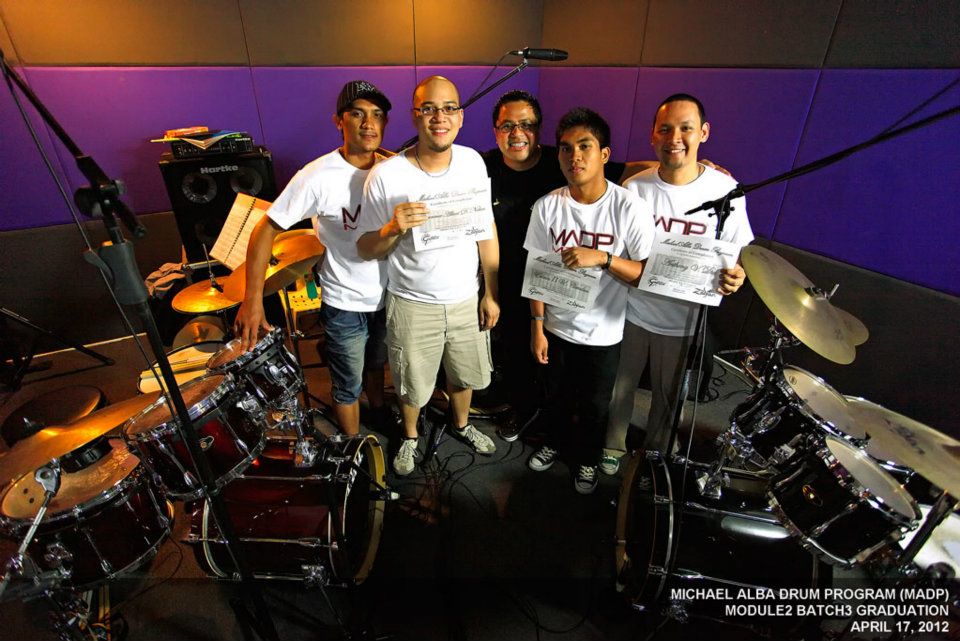 |
| MADP Module 2, Batch 3: From left-right: Weng Saavedra, Lawrence Alba, Master Michael Alba, Ed Catalan, and Anthony Dio |
A couple of months ago, I just finished the Module 2 Program, which took every drumming and musical aspect notches higher and further challenged our drumming, in terms of technique, performance & creativity. The way I see it, Module 2 is a super-sized version of Module 1, which pushed me and my peers to our limits. In no particular order...

Module 2 simulates real-life career situations, and it pushed me to manage my time and practice habits. Every Module 2 homework consists of at least 3 challenging play-along tracks and a couple of creativity exercises which challenged us to create our own original parts. So it was also an exercise on time management, as we juggled our woodshedding hours with our nightly gigs, day jobs, school, quality time with loved ones, and whatever routine or schedule we're going through our everyday lives. And with how Sir Mike gave out our assignments, he's like a musical director handing out the pieces we needed to play, and we only had a few days to nail down everything! So it was like a real-life session scene, where we're expected to be on top of our game, learn new materials fast and effectively, and be able to come out with drum parts which will work for the music.
Module 2 pushed me to work harder on my sight reading. For me, the Module 2 Applied Sight Reading (ASR) Exercises are like Module 1 ASR Exercises, but on steroids! With its various mixes of notes, rests, and figures (in particular, plenty of triplets, sixteenths and thirty-second notes, and don't forget the infamous fermata), these are guaranteed to be incredibly challenging, even for drummers who are already used to sight reading. But once mastered, or at least be able to go through it, it will greatly help with our sight reading skills, plus our speed, endurance, articulation, and dynamics. Well, I'm still not the fastest sight reader, but thanks to the Module 2 ASR exercises (plus the more challenging play-along charts), my reading skills improved.

Module 2 pushed me to further respect and appreciate the drumming gods. It's not that I do not revere the likes of Jeff Porcaro, Steve Gadd, Dave Weckl, John Robinson, David Garibaldi, Will Kennedy, Vinnie Colaiuta, and all these amazing drummers (I love and worship them all!). In Module 2, we learned how to play their classic drum parts correctly and with conviction. So our respect, admiration, and fascination for these legends grew deeper.
Module 2 pushed me to become more creative. With the thousands of amazing drum licks and chops already invented and played over the years, are we still capable of creating a new, original drum part? The answer is YES, and Sir Mike's system made our creative juices flow, as we orchestrated our original fill-ins during the Module 2 sessions. Plus, whether we love soloing or not (I don't consider myself a good drum soloist, and I often dread playing drum solos), there were several activities in Module 2 which challenged us to perform effective drum solos, which should still be a musical statement instead of just scattered pieces of notes, chops, and licks.
 I
can go on and talk more about Module 2. But of course, I don't want to
give away too much information (for the sake of future Module 2
students). The bottom line is, Module 2 is big boy stuff.
It will push you hard. It will challenge you. It will inspire you.
And it can even frustrate you (in a constructive way). But at the end
of the day, as long as you persevere, remain patient, and work hard on
practicing and honing your craft, going through Module 2 is a very
rewarding experience.
I
can go on and talk more about Module 2. But of course, I don't want to
give away too much information (for the sake of future Module 2
students). The bottom line is, Module 2 is big boy stuff.
It will push you hard. It will challenge you. It will inspire you.
And it can even frustrate you (in a constructive way). But at the end
of the day, as long as you persevere, remain patient, and work hard on
practicing and honing your craft, going through Module 2 is a very
rewarding experience.Thank you very much Michael Alba for being a wonderful and inspiring mentor. You did it again, Sir Mike! You are a blessing to me and my peers. Thank you for your passion, generosity and positive spirit. To my Module 2 Batch 3 classmates - Lawrence Nolan, Weng Saavedra, and Ed Catalan: It was an amazing Module 2 adventure with you guys. Thanks for the friendship and support! To Doc Jigs Asinas, Module 2 Batch 3 misses you! To Kent Pedraja of KNR Studio in Cubao, Quezon City, thank you very much for the excellent venue for our graduation day and drumshed session! To fellow Mike Alba Drum Program graduates Ruben Tecson, Christian Enriquez, Nigel Norris, and Otep Conception, thank you very much for all the help, brotherhood, enthusiasm and laughter during our Module 2 Graduation Day!
Best wishes to all our drumming and musical endeavors! God bless Mike Alba Drum Program!
 |
September 23, 2011
Another Broken Pedal... A Gibraltar This Time
Early this month, another bass drum pedal broke while I was using it. This time, it's a Gibraltar Intruder double chain bass drum pedal.
 It
happened during the middle of our last song of the night at my band's
bar gig. The Gibraltar's baseplate just gave in. And it's shocking to
me because first of all, I can't believe that another pedal gave in
while I was playing it (and I'm not even an abusive drummer who
finds pleasure in breaking stuff). And second, it's a Gibraltar, and
it's NOT supposed to happen to a reputable hardware brand/product like
it.
It
happened during the middle of our last song of the night at my band's
bar gig. The Gibraltar's baseplate just gave in. And it's shocking to
me because first of all, I can't believe that another pedal gave in
while I was playing it (and I'm not even an abusive drummer who
finds pleasure in breaking stuff). And second, it's a Gibraltar, and
it's NOT supposed to happen to a reputable hardware brand/product like
it.
The baseplate simply broke into two. And upon inspection, my drummer friend Joel David and I noticed that the baseplate isn't thick or strong enough to support repetitive heavy playing.
It's quite disappointing, considering that it's among the higher-end Gibraltar models. First, it was the DW 5000s (as documented on these blogs - Part 1 & Part 2). Now I'm gonna add Gibraltar to my pedal blacklist. I'm really going back to those strong, reliable, good old Tama pedals...

The baseplate simply broke into two. And upon inspection, my drummer friend Joel David and I noticed that the baseplate isn't thick or strong enough to support repetitive heavy playing.
It's quite disappointing, considering that it's among the higher-end Gibraltar models. First, it was the DW 5000s (as documented on these blogs - Part 1 & Part 2). Now I'm gonna add Gibraltar to my pedal blacklist. I'm really going back to those strong, reliable, good old Tama pedals...
 |
| A part of the broken baseplate's still screwed underneath the heel board. The non-slip rubber mat is still attached to the larger half of the broken baseplate. |
 |
| Gibraltar Intruder: blacklisted. |
Photos courtesy of Joel David.
May 5, 2011
Mike Mangini: New Drummer of Dream Theater
Finally, Dream Theater introduced their new drummer a few days ago, replacing the mighty Mike Portnoy. Way to go, Mike Mangini! The three-part The Spirit Carries On video series which documented Dream Theater's search for a new drummer, highlighted by the audition of seven world-class technical drummers.
Thanks to this video series, which was recently uploaded by RoadRunner Records on YouTube, I gained respect and appreciation of Mike Mangini's talent, abilities, and attitude. At first, I was thinking of Marco Minnemann, who I think would have been also a great fit for Dream Theater. But I thought that Mike Mangini would do a wonderful job in carrying the torch.
* Check out Mike Mangini's interview (04 May 2011) on Modern Drummer Online.
* You can backread My Sentiments on Mike Portnoy (and his Dream Theater departure), written on September 14, 2010.
Thanks to this video series, which was recently uploaded by RoadRunner Records on YouTube, I gained respect and appreciation of Mike Mangini's talent, abilities, and attitude. At first, I was thinking of Marco Minnemann, who I think would have been also a great fit for Dream Theater. But I thought that Mike Mangini would do a wonderful job in carrying the torch.
* Check out Mike Mangini's interview (04 May 2011) on Modern Drummer Online.
* You can backread My Sentiments on Mike Portnoy (and his Dream Theater departure), written on September 14, 2010.
February 17, 2011
My First Attempt in Cooking: Basil Pesto
Belated Happy Valentine's, everyone!
I'd like to share a few photos of my first-ever attempt in cooking. This is quite a big deal for me because I've never tried cooking special dishes. Eating and frying are just two of my most natural skills when it comes to food. Until finally, I thought that it's never too late to learn (of course), and it's about time that I try doing something new and worthwhile. Here are a few photos of my first-ever pasta dish: Basil Pesto.
Yeah I know this is a piece of cake for some of you folks out there who cook a lot. My noodles may not be perfectly cooked, but I'm quite proud of what I just made. It's delicious, and my Mom and Dad even enjoyed it! Now I know why cooking can be such a rewarding thing to do. Not bad for a novice in the kitchen!
I'd like to share a few photos of my first-ever attempt in cooking. This is quite a big deal for me because I've never tried cooking special dishes. Eating and frying are just two of my most natural skills when it comes to food. Until finally, I thought that it's never too late to learn (of course), and it's about time that I try doing something new and worthwhile. Here are a few photos of my first-ever pasta dish: Basil Pesto.
 |
| My ingredients. |
 |
| Good thing we have this electric chopper handy. Every kitchen should have one. |
 |
| First-ever basil pesto creation... Not bad! |
 |
| I used whole wheat noodles, which makes it quite a more healthful treat. |
 |
| Okay, let's eat! =) |
Yeah I know this is a piece of cake for some of you folks out there who cook a lot. My noodles may not be perfectly cooked, but I'm quite proud of what I just made. It's delicious, and my Mom and Dad even enjoyed it! Now I know why cooking can be such a rewarding thing to do. Not bad for a novice in the kitchen!
Special thanks to A for the special recipe*. =)
* It's a secret recipe. Sorry I can't post it here. =D
January 6, 2011
UKZ - Radiation
Happy New Year, folks!
To kickstart my blog this 2011, I'm sharing this music video of an awesome progressive rock piece by virtuoso supergroup UKZ, featuring German superdrummer & ambidextrous technical wizard Marco Minnemann.
UKZ is a virtuoso supergroup formed by former 'UK' keyboard/electric violin legend Eddie Jobson with ex-King Crimson stick player Trey Gunn; Austrian guitar prodigy Alex Machacek; former Expanding Man vocalist Aaron Lippert; and German drumming phenom Marco Minnemann.
The video features some great overhead shots of Marco, showing some of the challenging things that he can effortlessly do on the drumkit. Plus, I'm digging his Ghost In The Machine (The Police) t-shirt.
I'm also opening the year with the most curious inquiry... How true is it that Marco Minnemann is the new drummer of Dream Theater? Honestly, I think that'll be a very exciting team-up, musically.
*Special thanks to my friend, Fuseboxx guitarist Michael Ong, who shared this video on Facebook months ago.
To kickstart my blog this 2011, I'm sharing this music video of an awesome progressive rock piece by virtuoso supergroup UKZ, featuring German superdrummer & ambidextrous technical wizard Marco Minnemann.
UKZ is a virtuoso supergroup formed by former 'UK' keyboard/electric violin legend Eddie Jobson with ex-King Crimson stick player Trey Gunn; Austrian guitar prodigy Alex Machacek; former Expanding Man vocalist Aaron Lippert; and German drumming phenom Marco Minnemann.
The video features some great overhead shots of Marco, showing some of the challenging things that he can effortlessly do on the drumkit. Plus, I'm digging his Ghost In The Machine (The Police) t-shirt.
I'm also opening the year with the most curious inquiry... How true is it that Marco Minnemann is the new drummer of Dream Theater? Honestly, I think that'll be a very exciting team-up, musically.
*Special thanks to my friend, Fuseboxx guitarist Michael Ong, who shared this video on Facebook months ago.
December 16, 2010
My DW Pedal Broke, Part 2: The Broken Piece
For Part 1 of this blog, click here - My DW Pedal Broke (27 Nov 2010).
*****
Almost three weeks after the chain piece of the primary pedal of my DW 5002AH double bass pedal snapped, I finally found some spare time yesterday afternoon to tinker with the pedal, remove the broken part, and inspect it. I took a couple of photos of the damaged metal piece of the DW double chain, which is the strip that connects the chain to the footboard (using a nut and screw).


Detaching the broken chain from the footboard was tough because it was screwed way too tight. I was almost at the point of ruining the Phillips head of the screw. Why are DW's pedal parts screwed on very very tight? Good thing I found an old pair of pliers with a very strong grip, to hold the nut underneath.
Like I mentioned on the first blog, I'm not heavy-footed, I've never broken a high-end bass pedal before this incident due to malpractice or carelessness, and it's unlikely that the double pedal's previous owner/s tampered, modified, or maltreated it. I guess it's simply a matter of good old mechanical wear & tear, and perhaps some bad luck.
Yet I still feel that a product that's supposed to be well-thought out, mechanically sound, and of high quality shouldn't give in just like that. I have drummer buddies who've owned and played DW pedals for years and even decades, but how come their DWs never broke down like that?
Now that I've seen the actual damage, I placed an order for a new DW double chain (courtesy of Vinci Rodriguez of The Drum Shop Manila). Now all I need to do is wait.
*****
Almost three weeks after the chain piece of the primary pedal of my DW 5002AH double bass pedal snapped, I finally found some spare time yesterday afternoon to tinker with the pedal, remove the broken part, and inspect it. I took a couple of photos of the damaged metal piece of the DW double chain, which is the strip that connects the chain to the footboard (using a nut and screw).


Detaching the broken chain from the footboard was tough because it was screwed way too tight. I was almost at the point of ruining the Phillips head of the screw. Why are DW's pedal parts screwed on very very tight? Good thing I found an old pair of pliers with a very strong grip, to hold the nut underneath.
Like I mentioned on the first blog, I'm not heavy-footed, I've never broken a high-end bass pedal before this incident due to malpractice or carelessness, and it's unlikely that the double pedal's previous owner/s tampered, modified, or maltreated it. I guess it's simply a matter of good old mechanical wear & tear, and perhaps some bad luck.
Yet I still feel that a product that's supposed to be well-thought out, mechanically sound, and of high quality shouldn't give in just like that. I have drummer buddies who've owned and played DW pedals for years and even decades, but how come their DWs never broke down like that?
Now that I've seen the actual damage, I placed an order for a new DW double chain (courtesy of Vinci Rodriguez of The Drum Shop Manila). Now all I need to do is wait.
 |
dwsm1204 - 3000/5000/7000 Double Chain with Link. Fits 3000, 5000 and 7000 series pedals. Photo from the DW website. |
December 11, 2010
Mike Alba's Muscle Memory Workout Program (Module 1)
 |
| From L-R: Anthony Dio, Lawrence Nolan, Dr. Jigs Asinas, Paulo Garganta, Dom Banguis, & Sir Michael Alba. |
Prior to enrolling in this program, my need for improving my drumming has grown greatly & I've been yearning for some musical inspiration. I always see myself as an endless apprentice to the art of drumming, and I always wanted to grow and develop as an artist & take my craft to the next level. And specifically, I also needed to improve my technique. Just when I was searching for some education and inspiration, Mike Alba and his Muscle Memory Workout Program came in. It was a blessing & a matter of right timing.
 |
| Batch 2. |
I don't want to give away too much information regarding what was covered throughout Mike Alba's program (for the sake of Sir Mike's future students). But here's what I can share. Everything I learned in Mike Alba's program is totally practical and useful to me as a working pro. Though I still need to continuously practice the exercises and sharpen my technique and note-reading, I instantly felt a huge difference in my playing. In fact, just after Day 1 of the 10-day program, I can already feel and hear the difference. And it's cool that my bandmates even noticed it. On one gig, they were like, "Hey, there's something new here!", and "I can hear those sixteenth notes much better now!" I'm still a work in progress, but I sure owe it to Sir Mike.
Mike Alba's modified Virgil Donati workout indeed does wonders to a drummer's hands. Like Sir Mike, this has already become part of my pre-performance or pre-practice warm-up routine. Sir Mike recommends that we do it at least once a day. We can do it twice a day, and we'll get much better. And we can do it three times a day, and we'll become invincible! As long as this becomes part of our daily drumming routine, the results are guaranteed. It's a great muscle memory workout for the fingers, hands, wrists, and arms, and it's a great help for our endurance, control, technique, dynamics, and articulation.
 I'm already quite familiar with some of the most commonly used rudiments, such as singles, doubles, and paradiddles. But when Sir Mike presented us his workout on rudiments, it was an added dimension for me. First, since the rudiments were on paper, it was also a sight reading exercise, so it's a muscle memory workout for the eye. And second, Sir Mike focused on some of the rudiments which are commonly applied on the drumkit, and he also shared some interesting ideas on how we can integrate it with our grooves and fills. With practice and patience, these rudiments can serve as additional vocabulary in our drumming arsenal.
Admittedly, I'm a slow sight reader, and the last time I actually sight-read drum charts on a regular basis was way back during my college days with the DLSU Pops Orchestra. Sir Mike's applied sight reading exercises are a huge help. For me, it was like a review and a rediscovery. This also serves as a coordination workout between the eyes and the limbs. The sight reading pieces were written by Sir Mike, and in the program, it is played on the snare drum or practice pad. One cool thing about this is he used some of the most commonly used figures on session work, such as eighth, sixteenth and triplet note combinations. So this serves as another muscle memory workout for the eyes. Sir Mike also encourages us to be melodic by trying to sing these figures & play it around the drumkit instead of just on the snare drum or pad. Again, these can be used as additional tools in our drumming vocabulary. Plus, Sir Mike helped me in becoming more confident with my reading skills.
 My favorite part of the class is what I like to call the groove session. This is where we listen to songs (for the program, Sir Mike has selected a repertoire of actual recordings coming from different styles and eras), then develop musical roadmaps, write drum charts, and play along to those recordings on the drumkit. For me, this is the most musical part of the class. Though it's my favorite part, it can be the most grueling. Our assignments of charting the songs, learning it, and playing along with it is not as simple as it sounds. Several songs may seem simple to play, but it's not as easy as it sounds. Sir Mike wants to make sure that we nail it right, for these are valuable skills required for session work. For me, these exercises also serve as training tools for our listening skills, our attention to detail, our musicality, and our discipline. As a pro, I've been covering songs for years. But now, Sir Mike's methods help me enhance these skills, which are essential for pro drummers who do session work or in pop/mainstream settings. The groove sessions also taught us and reminded us of the value of respecting the music, plus we get to further appreciate the great drummers who played on the recordings.
 Every class ends with a Drumometer session, where each of us plays on a pad with a gadget that records the number of single strokes we play in one minute. At first, I wasn't really interested in developing my speed to extreme levels. But what I appreciate about the Drumometer is it's a great practice tool that can monitor our progress. And it's not only about speed. It also puts a great deal on control, endurance, and technique, which are factors in developing greater speed. And hence, the Drumometer can be tool that can help our hands become much better.
Other than the specific activities and lessons I mentioned, there are plenty more things that we have learned from Sir Mike. Finally, I learned how to play the brushes effectively (which is one of the favorite things I've learned from Sir Mike, since brushes have been a long mystery and frustration of mine). I also learned a few new tricks and licks around the drumkit. It's also cool that Sir Mike is very observant of our playing, whether on the drumkit or on a practice pad. Sir Mike is a patient and a very motivating mentor. He also makes it a point to correct our bad habits, and he does it in a professional and constructive manner. In my case, I've already adjusted some of my bad habits, and I'm still in the process of strengthening my left hand and my technique. Even if the program's over, it's still a continuous learning process. Mike Alba's program sure makes us spend more quality time on the woodshed.
I admit, it can be quite intimidating to play along to a track in the presence of one of the best drummers in the Philippines observing you nearby. But he's a really cool teacher, and he's very easy to get along with. There were moments too when Sir Mike gets to share his stories, such as his experiences as a pro, as a student at the Los Angeles Music Academy, and some of the famous drummers he met. Even all these talks and his sharing of knowledge and wisdom are inspiring.
One factor that I appreciate regarding Sir Mike's program is the fact that he is very particular with quality. We may have all the technique in the world. But if it doesn't sound musical and if it doesn't feel great, it won't matter at all. Sir Mike is like a quality control guy. He wants to make sure that we're not just technically solid, but we'll also be sounding and feeling great too. And quality means a lot on session work, which I realized and learned later on. It seems that Sir Mike's program is highly geared towards drummers who are in the session scene or in a mainstream setting. Hence, his program is highly recommended for drummers who aspire to have a fruitful career towards that direction. Though it's not limited to that; anybody who simply wants to improve or enhance their skills will greatly benefit with Sir Mike's program.
Another thing I appreciate so much in Mike Alba's program is the fact that we are a class of five students. Most drum lessons (or any other musical instrument) are traditionally one-on-one sessions. What's great about having classmates is first, it's great to meet new friends and extend the drumming camaraderie. Second, I get to appreciate my classmates' drumming. We may have similarities and differences in regards to musical backgrounds, preferences & tastes, among many things. We have our strengths and weaknesses as well. But it's cool that we are all on the same boat. Each of us still wants to push on and improve with our craft, which is why we're studying with Mike Alba. It's also understood that being in a class is not about competition, which takes us to my next point. Third, we get to gauge each other in terms of improvement. It's like for example, when I notice my classmates already improving on their rudiments or sight reading or their Donati workout routine, I tell myself, "I better catch up!" It's like a subconscious way of encouraging myself. And on the other end, if some classmates are catching up or having some difficulty, the rest of us would express our encouragement. It's not about outdoing each other. To be in Mike Alba's classes is a brotherhood, where my respect and admiration for each of my classmates have grown as the sessions passed.
 |
| The apprentice & the master. |
Thank you very much, Sir Mike Alba. You're a blessing to all of us. Just when I needed improvement and inspiration, you came along like an answered prayer. You're an awesome world-class musician and an inspiring mentor, and I'll always cherish the times spent & all the lessons I learned from you. Continue to be an inspiration to me and to everyone. And to my Batch 2 classmates --- Lawrence Nolan (my seatmate & our Drumometer king), Paulo Garganta (all the way from Batangas; thanks again for the coffee & all the talk on the road), Dom Banguis ("speak softly; carry a BIG stick" --- wow those are HUGE warm-up drumsticks!), and Dr. Jigs Asinas (the heavy metal guy & the most "well-compensated" among us; one of the most humble and down-to-earth dudes I've ever met) --- it's my pleasure to meet you and be classmates with you guys. I admire and respect all of you, and studying & learning is a blast when it's spent with good people like you. Great drumming! Cheers to Sir Mike! Cheers to all of us!
And so, that's all for Module 1. Module 2, which will be set sometime next year, is in the works. And the work in progress goes on...

*Photos courtesy of Sir Mike Alba & Dr. Jigs Asinas.
November 27, 2010
My DW Pedal Broke
This just happened last night.
My DW 5002AH Delta 2 double bass pedal is an old model (circa 2002, i suppose), and I bought it second-hand from a good friend just a couple of months ago. Prior to purchase, I made a pretty good inspection of this double bass pedal. Though it's an older model and it needed some cleaning, I didn't locate any issues or potential problems. It was still mechanically sound, and most important, its action and response still feels great. It's a nice set of pedals, and I enjoyed using it in the last ten weeks or so. Until...
During our gig, somewhere in the middle of a song, something went wrong with the primary (right/main) pedal. The chain just separated with the footboard, which forced me to use the slave (left/auxiliary) pedal for the remainder of the song. Good thing we were playing a slow jam R&B tune when it happened. If it was an upbeat tune with plenty of bass drum doubles or syncopations, it could have been my doom.
After that song, I quickly unhooked the primary pedal from the bass drum hoop to check out what happened. It turned out, this small piece of metal that connects the chain to the footboard just snapped.
It's no quick fix. The chains seem to be riveted on to the sprocket. The broken little piece of metal looks like it either needs to be replaced, modified, welded, or super-glued with an extra-strong steel epoxy. And so, I set aside the broken DW and went for the house kit's sloppy yet still functional Gibraltar bass pedal.
I don't know if this is an isolated case. I don't know if this is a common problem experienced by other DW pedal players. I don't know if it's just plain bad luck and I don't think the previous owner/s already tampered or modified this pedal. But one thing I'm certain of is this is another one of many DW pedal durability and reliability issues, and it's sad to say that I got turned off with it. I don't think I'll ever buy another DW pedal.
Prior to this incident, I've never broken a high-end pedal. It's the first time in my whole drumming life that something like this happened to me. And I'm not the heavy-footed type, which is why it's quite a surprise for me. I guess it's either I have this fixed in a machine shop or order genuine replacement parts, whichever's more convenient or more reasonable. Then perhaps I'll sell it and upgrade to a better one. I think I'll go back to those Japanese pedals, which are more durable and more reliable. Or better yet, if my budget persists, I'll invest on one of those high-tech direct-drive pedals.
It sucks that I'm pedal-less again, for now. Once again I have to rely on what's provided on the gig venues, or if there's a good soul out there who's willing to lend me a pedal while I don't have a new one. But what's more frustrating is it's also a matter of wrong timing. Just when I'm totally inspired to practice more nowadays & I'm in the midst of preparing for the last couple of days of my drum workshop with Mike Alba, the DW pedal gave in, and I don't have a spare pedal at home. I'll never own a DW pedal again.

 |
| My broken DW 5000 pedal. |
 |
| A view of that broken metal piece... |
During our gig, somewhere in the middle of a song, something went wrong with the primary (right/main) pedal. The chain just separated with the footboard, which forced me to use the slave (left/auxiliary) pedal for the remainder of the song. Good thing we were playing a slow jam R&B tune when it happened. If it was an upbeat tune with plenty of bass drum doubles or syncopations, it could have been my doom.
 |
| ... that connects the chain to the footboard. |
It's no quick fix. The chains seem to be riveted on to the sprocket. The broken little piece of metal looks like it either needs to be replaced, modified, welded, or super-glued with an extra-strong steel epoxy. And so, I set aside the broken DW and went for the house kit's sloppy yet still functional Gibraltar bass pedal.
I don't know if this is an isolated case. I don't know if this is a common problem experienced by other DW pedal players. I don't know if it's just plain bad luck and I don't think the previous owner/s already tampered or modified this pedal. But one thing I'm certain of is this is another one of many DW pedal durability and reliability issues, and it's sad to say that I got turned off with it. I don't think I'll ever buy another DW pedal.
 |
| This is where the chain meets the footboard. Broken. |
It sucks that I'm pedal-less again, for now. Once again I have to rely on what's provided on the gig venues, or if there's a good soul out there who's willing to lend me a pedal while I don't have a new one. But what's more frustrating is it's also a matter of wrong timing. Just when I'm totally inspired to practice more nowadays & I'm in the midst of preparing for the last couple of days of my drum workshop with Mike Alba, the DW pedal gave in, and I don't have a spare pedal at home. I'll never own a DW pedal again.
 | |
| This should be my first and last DW pedal. Disappointment. |
November 26, 2010
Musical Inspirations - November 2010
This month, three musical events inspired me so much as a drummer and musician.
First is the "Muscle Memory Workout Program", a drum workshop designed and mentored by the great Filipino session drummer Mike Alba, which is still ongoing. I'm planning to write a blog about this experience after our graduation day about two weeks from now.
Second is The Wedding Singer. Most of the musicians from this production, who are all part of the Manila Philharmonic Orchestra, are good friends of mine. Thanks to Criss Buenviaje, my church bandmate & one of the guitarists in the musical, I was able to watch the hit musical and the musicians from the orchestra pit, which was a highly interesting and educational experience for me.
The hit theater rendition of The Wedding Singer was as funny and as charming as its original movie version, and it would be great if they do a repeat run. I had a great time watching the musical, though I had a much more enjoyable time watching the musicians do some live theater work. My friends from MPO who were part of The Wedding Singer include drummer Junjun Regalado, bass player JC Magsalin, and guitar players Adam Cesante and Criss. With them are three senior piano/keyboard players who are seasoned, veteran musicians. So, The Wedding Singer Band is a group of seven highly-qualified and highly-skilled musicians.
What really struck me about performing on musicals is how high the stress levels are, especially with drummers. I was keenly observing Junjun, who was using a set of Roland V-Drums electronic kit for this musical (which is appropriate, since the storyline's set in the 1980's). What he's doing throughout the show is one grand juggling act. Besides his obvious job of playing the drums, he also needs to cue the band and the actors on some scenes, he needs to set the tempo (with the help of a metronome on his left side), and he needs to make sure that he's using the proper drum sounds/patches, which are indicated on their charts (while note-reading is another major chore!).
It's amazing how Junjun pulls it off, and it seems like there's no difficult gig a talented and experienced professional drummer like him can't handle. I would imagine what could happen if things go wrong and a little mistake can become one domino effect of tragic proportions. The other guys may also have their respective cues during the show, but Junjun's cues are so crucial. In fact, there was one part of the show where Junjun almost missed a cue, which should be nerve-racking for any musician. Yet somehow, they were able to pull it off and get back on track, which JC told me was among their on-the-spot Plan B schemes, in case a worst-case scenario happens.
Upon witnessing these fine musicians at work in the pit, I've come to realize once more the value of a very good drummer in a band or a production. No doubt, drummers are the foundation of great bands. And Junjun sure did one heck of a mighty fine job. I already know that these friends of mine are quality musicians who I revere so much. But after observing them at work at The Wedding Singer, my respect and admiration for them just grew much greater.
 Third is the piano/keyboard clinic by the talented Nikko Rivera, a known prodigy on the keys who is now an ace session musician and a member of the Filipino supergroup Yosha (which also includes Mike Alba on drums, Karel Honasan on bass, and Yosha on vocals). Nikko is an endorser of Korg musical instruments, and his clinic was organized by local Korg distributors Audiophile. It was held at the Audiophile showroom in Robinson's Otis Mall in Paco, Manila just last Wednesday (November 24).
Nikko's clinic/program was divided in three parts. First was the classical set, where he had a duet with a cellist, playing a Mozart piece. Second was the jazz quartet setting, where he played with a drummer, a double bassist, and a trumpet player. And last but not the least, he played with his band Yosha, playing a Latin jazz tune (from Michel Camilo), a fusion tune (from The Yellowjackets), and a special arrangement/medley of their original songs. All these performances from Nikko and his crew of superstar-caliber musicians were totally awe-inspiring.
For me, a musician like Nikko Rivera is so inspiring not only because he's a natural talent, but also because it's obvious that he is passionate with music, he has dedicated himself to his craft, and he worked hard to get where he is right now. At a relatively young age, he's already got tons of musical experiences on his profile, he's been to different places & he's already played with so many notable artists. Now, he's an official Korg artist, and with his current musical career, there's no way to go but up and he's still got many more years to make music. Same goes for the musicians Nikko has played with during his clinic. Each musician is continuously studying and working hard to master their chosen instrument, and their heart and dedication are undeniable.
Which is why it's always healthy for me as a musician to go out and witness incredible musicians at work. It's always a humbling reminder for me to work harder and to continue improving with my craft. I salute all the fine musicians out there, and I thank you all for the inspiration.
* Photo of JC Magsalin & Junjun Regalado courtesy of Criss Buenviaje.

First is the "Muscle Memory Workout Program", a drum workshop designed and mentored by the great Filipino session drummer Mike Alba, which is still ongoing. I'm planning to write a blog about this experience after our graduation day about two weeks from now.
Second is The Wedding Singer. Most of the musicians from this production, who are all part of the Manila Philharmonic Orchestra, are good friends of mine. Thanks to Criss Buenviaje, my church bandmate & one of the guitarists in the musical, I was able to watch the hit musical and the musicians from the orchestra pit, which was a highly interesting and educational experience for me.
 |
| JC Magsalin & Junjun Regalado at work. |
What really struck me about performing on musicals is how high the stress levels are, especially with drummers. I was keenly observing Junjun, who was using a set of Roland V-Drums electronic kit for this musical (which is appropriate, since the storyline's set in the 1980's). What he's doing throughout the show is one grand juggling act. Besides his obvious job of playing the drums, he also needs to cue the band and the actors on some scenes, he needs to set the tempo (with the help of a metronome on his left side), and he needs to make sure that he's using the proper drum sounds/patches, which are indicated on their charts (while note-reading is another major chore!).
It's amazing how Junjun pulls it off, and it seems like there's no difficult gig a talented and experienced professional drummer like him can't handle. I would imagine what could happen if things go wrong and a little mistake can become one domino effect of tragic proportions. The other guys may also have their respective cues during the show, but Junjun's cues are so crucial. In fact, there was one part of the show where Junjun almost missed a cue, which should be nerve-racking for any musician. Yet somehow, they were able to pull it off and get back on track, which JC told me was among their on-the-spot Plan B schemes, in case a worst-case scenario happens.
Upon witnessing these fine musicians at work in the pit, I've come to realize once more the value of a very good drummer in a band or a production. No doubt, drummers are the foundation of great bands. And Junjun sure did one heck of a mighty fine job. I already know that these friends of mine are quality musicians who I revere so much. But after observing them at work at The Wedding Singer, my respect and admiration for them just grew much greater.
 Third is the piano/keyboard clinic by the talented Nikko Rivera, a known prodigy on the keys who is now an ace session musician and a member of the Filipino supergroup Yosha (which also includes Mike Alba on drums, Karel Honasan on bass, and Yosha on vocals). Nikko is an endorser of Korg musical instruments, and his clinic was organized by local Korg distributors Audiophile. It was held at the Audiophile showroom in Robinson's Otis Mall in Paco, Manila just last Wednesday (November 24).
Nikko's clinic/program was divided in three parts. First was the classical set, where he had a duet with a cellist, playing a Mozart piece. Second was the jazz quartet setting, where he played with a drummer, a double bassist, and a trumpet player. And last but not the least, he played with his band Yosha, playing a Latin jazz tune (from Michel Camilo), a fusion tune (from The Yellowjackets), and a special arrangement/medley of their original songs. All these performances from Nikko and his crew of superstar-caliber musicians were totally awe-inspiring.
For me, a musician like Nikko Rivera is so inspiring not only because he's a natural talent, but also because it's obvious that he is passionate with music, he has dedicated himself to his craft, and he worked hard to get where he is right now. At a relatively young age, he's already got tons of musical experiences on his profile, he's been to different places & he's already played with so many notable artists. Now, he's an official Korg artist, and with his current musical career, there's no way to go but up and he's still got many more years to make music. Same goes for the musicians Nikko has played with during his clinic. Each musician is continuously studying and working hard to master their chosen instrument, and their heart and dedication are undeniable.
Which is why it's always healthy for me as a musician to go out and witness incredible musicians at work. It's always a humbling reminder for me to work harder and to continue improving with my craft. I salute all the fine musicians out there, and I thank you all for the inspiration.
* Photo of JC Magsalin & Junjun Regalado courtesy of Criss Buenviaje.
November 16, 2010
RIP Sir Wyngard Tracy

Rest in peace, Sir Wyngard Tracy, my former boss back in my 7th Soul/Artistation days. Thank you for teaching us the values of professionalism and good work ethic.
We may not be that close with you & we may not be as high-profile as many of your talents, but career-wise you has been crucial to my development as an artist.
If it wasn't for you, I may never have met the legendary Filipino drummer Mar Dizon. Thank you Sir Wyn for taking care of my drum lessons with Senyor Mar back in the day.
May God bless your soul.
Photo from pep.ph --- http://www.pep.ph/news/27396/Talent-manager-Wyngard-Tracy-passes-away .
November 11, 2010
Fil-Am Drummer Susie Ibarra on Modern Drummer December 2010

Finally, I was able to get my copy early this week. The first thing I did was to go straight to the pages of her MD feature and scan through the interview and find references of her Filipino roots and heritage.
"That (a track on Drum Sketches) was recorded in the south of the Philippines at the Shariff Kabunsuan Festival, on the last day during a fluvial or boat parade. All of the provinces in the area compete for a cash prize. They decorate their boats with multicolored flags, and there are thirty people on each boat playing kulintang ensemble gong music. They come down the river with this massive sound. You have different gong ensembles crossing the river, producing waves of sound."
"When I first took him (her husband, Cuban percussionist Roberto Juan Rodriguez) to see the parades in the Philippines, they reminded him of his native Cuba. He related as a Cuban artist in the way the interlocked rhythms worked, especially with the bass gong. It added that Cuban drive to the music."
"We (Susie & husband Roberto) both come from dance cultures. Filipinos and Cubans love to dance. Rhythm is in the community --- in Cuba, if you want to learn piano, they put you on drums first --- and that explains why in Cuba and the Philippines they have such a deep pocket and culture of rhythm."
- Susie Ibarra, Modern Drummer, December 2010
She also cited the albums Pakaraguian sa Maguindanao: A Celebration of Kulintang Music And Dance by Danongan Kalanduyan & Palabuniyan Kulintang Percussion Ensemble, and Asibang-Lan, Pinukpok, Balbalan, Gong, and Percussion Music: Ang Musika Ng Mga Kalinga Music From The Kalinga in Northern Luzon, Philippines by various artists as among her favorite albums. I wonder where I can find these albums. It's also cool to see some Filipino names & terms printed on an international drumming publication.
Admittedly, I have yet to listen to Susie Ibarra's numerous recordings, which are hard-to-find and not easily accessible on this side of the world. I only get to hear some audio samples and watch some of her videos posted on YouTube. Yet I am in great admiration of Susie Ibarra's works and her intention of celebrating her Filipino heritage by incorporating some of our indigenous instruments and rhythms to her music. Her intention of introducing and educating her audience to Philippine rhythms and ethnic instruments should be given recognition.
Applying our Filipino indigenous rhythms and instruments to modern styles of music is something that I would love to do someday, as documented on my blogs about the Filipino ethnic instruments workshop I attended last July*. While Susie Ibarra may be applying it through jazz and world music, I am hoping to find a way to incorporate it with modern or contemporary musical styles. It would be great if it can be done in a mainstream or pop setting, so that it can reach an even greater audience.
Susie Ibarra is a talented and creative drummer, percussionist and rhythmatist who, as Modern Drummer described it, "extends beyond boundaries, beyond cliche, and beyond a common understanding of what a drummer's role is and ultimately can be." I do hope that she would conduct shows and an educational seminar here in Manila in the near future. And I do hope that more Filipinos would recognize her. Susie Ibarra is proud of her Filipino heritage. And Susie Ibarra is a world-class artist whom we Filipinos can be proud of.
* My Filipino Ethnic Music Instruments 101 Experience - Part 1 (July 21, 2010) & Part 2 (July 24, 2010).
Check out Susie Ibarra's website, which is cool because there are several photos there which reflect her pride of her Filipino roots.
Orianthi - Courage (feat. Lacey of Flyleaf)
I've been an admirer of Australian singer-songwriter-guitarist Orianthi ever since I first heard and saw her on Michael Jackson's This Is It. Here's her latest song, which is fast becoming a favorite of mine because of the strong message it conveys. The song speaks for itself. Plus with the way it's played, this song feels great. What an awesome, kickass song!
"It's not how many times you've been knocked down. It's how many times you get back up."
November 5, 2010
Journey Live In Manila DVD
"Rarely is a band given a chance to capture a crowning moment that followed a period of discovery, new beginnings and fulfillment."
- From the Journey Live in Manila DVD booklet.
 March 14, 2009, Mall Of Asia Concert Ground, Manila... I experienced the best rock concert I've ever attended. And it was not just another concert by Journey, one of the most successful and most enduring supergroups in rock and music history. It was a celebration of Filipino pride, talent, and spirit; a special homecoming for Arnel Pineda, one of the all-time best Filipino rock singers. I documented my Journey concert experience in my mid-March 2009 blog.
I'm so glad the producers filmed this monumental concert. For those who were present in that two-and-a-half hour show one hot mid-March evening last year, this is a neatly-packaged remembrance and a chance to relive Journey's excellent performance & Arnel's moment of glory. And to those who missed the concert, you need to grab a copy of this DVD. Buy the original DVD, enjoy the concert, read the liner notes about Arnel's humble beginnings and opportunity of a lifetime, and be proud to be a Filipino.
Whenever I watch the concert DVD at home, I always get a healthy dose of inspiration and a sense of pride. Many times I would get the goosebumps & go teary-eyed, from the moment Arnel enters the stage to start the concert, during times when Arnel says his spiels in Filipino and screams "Proud to be Pinoy!", to those tear-jerking moments whenever Arnel hits the high notes or finishes a killer ballad with so much power and passion.
If you haven't seen the Journey Live in Manila DVD yet, especially to my fellow Filipinos, please do yourselves a favor. Go grab a copy now. The original DVD, of course.
*****
Special mention to my companions at the Journey concert in Manila: My friend and classmate from La Salle Greenhills, Ryan Manalastas; our dear friend who got us the concert tickets, Sunshine Mendoza; and to my good friend, my manager's husband, a fellow drummer & Arnel Pineda's close friend and former bandmate, Joel "Jumi" David. And yes, Jumi is seen many times at the Live in Manila video (in front of the stage, at the corner of the catwalk near guitarist Neal Schon's spot).
October 31, 2010
Gearhead Thoughts: Some New Gear
I've been busy these days, which is why I need to catch up with my blogging. In addition to my usual gigs with K24/7, I am currently having a few activities outside my band, such as session work (thanks to my friends from Hit Productions) & drum lessons under the mentorship of great Filipino drummer Mike Alba (which I plan to blog about next time). Being busy is a good thing for me, and I feel blessed because of these opportunities coming in. It also enabled me to purchase some new gear, which is not only a case of GAS (gear acquisition syndrome), but also a necessity. Most of the new stuff I got are for the sake of replacing some of my old gear which recently broke down or needed to be updated.
Here are some of the new gear which I recently acquired.
 I got this Zildjian 17" A Custom Rezo Crash cymbal from JB Music (Zildjian's local distributor) through their trade-in program. I traded my broken 17" K Custom Dark Crash for this new baby, which is among the latest line of cymbals from Zildjian. I love dark and contemporary-sounding cymbals, which explains my preference for K Custom cymbals all these years. I love how it blends in with my band's style of music & how elegant it sounds especially during recording situations. The rides and hats are beautiful stuff worth keeping. However, when it comes to crashes, I was beginning to look for something else. I've had Custom Darks and Hybrids. Though they all sound awesome, they are fragile, thin-profiled models & I don't get enough sound from them on some live situations, particularly with bigger venues.
When Zildjian introduced the new A Custom Rezos early last year, I thought these may be the solution to my search for a fresh new sound. Am I glad to have a Rezo Crash now, because I'm loving it! Prior to purchase, I made my research regarding the Rezo Crashes. Some said that if you like the K Custom Hybrids (which I do), you'll like the A Custom Rezos as well. The product review on the March 2009 issue of Modern Drummer, which described the Rezos as "having a great balance of volume, reaction, and quality of sound", was helpful too. The MD review was spot on! I love how the Rezo Crash explodes with just the right amount of tone and volume, with just enough sustain, and just enough cut without piercing our eardrums. My bandmates love it too, and complimented a number of times regarding how nice it sounds. This is among the sweetest-sounding crash cymbals I've ever used. It's also an added bonus that it's also a handsome-looking cymbal, with its different bands of lathes and the combination of brilliant and traditional finishes. Plus it's got a medium-thin profile, so this would be more durable than my previous K Customs. I think I'll get a bigger 18" or 19" Rezo for my right side next time.
 The Drum Dial is a gift from my US-based genius godfather Chit Ramirez (my uncle who gave me my Magic Drum). This is a really helpful piece of equipment. First of all, I can say that I'm pretty much used to tuning drums, based on feel plus all the years of experience. I thought I'm quite fine with my drum tuning skills, which is why I never really took notice of those drum tuning assistance gadgets coming out on the market in recent years. Until, my uncle got me this nifty piece of equipment which he and his musician friends from the US claim that it will be very useful for my craft. One week after using the Drum Dial to tune my drums, I can definitely hear and feel the difference! I'll be writing my review of the Drum Dial soon.
 My trusty five-year old Behringer Eurorack UB802 compact mixer's power supply blew up recently. Before this happened, I was already having thoughts of retiring this workhorse for home use (I'm planning to set-up a sound system at home for my play-along practice needs). So I need to have that power supply fixed. A few days ago, I got a new compact mixer for my stage monitoring requirements. I got Behringer's Xenyx 502 mixer. The eight-channel UB802 served me well, even if I'm unable to maximize it because I only use two channels most of the time - one for the live band mix & another for the sequenced tracks, plus an optional third channel for my metronome (when needed). So the five-channel Xenyx 502, which is almost similar to the old Eurorack UB502 used by former South Border drummer Paul Benitez back in the day, is pretty much just right for my basic stage monitoring set-up. It's also great that it's smaller (its footprint is just around 5"x7"), it's more lightweight, and it looks sleek with its black/gray finish (compared to the Eurorack's colder and more industrial-looking steel silver finish).
 Up to this day, I'm still frustrated over the loss of the left earpiece of my M-Audio IE-20 XB in-ear earphones (which I mentioned in this May 2010 blog). How I wish that somebody can help me with acquiring, if possible, just the left-side piece of this high-quality listening equipment (hope you're reading this, Drum Shop Manila and/or JB Music). Anyway, I've been reading and hearing stories about some side-effects of using in-ear earphones, which may damage the ear canal when not used properly. So I thought of using traditional headphones as an alternative. My top choice (and only choice) is the already-proven Vic Firth SIH1 Stereo Isolation Headphones,which are specially designed for drummers. Essentially, these are traditional earmuffs which have built-in speakers, which makes it an excellent play-along tool because it is highly effective for listening to music while blocking outside noise. Its fit is quite tight and snug, which is a good thing. That means I can still bob my head during live situations, and I don't need to worry about the headphones slipping off my head. The stereo sound may not be at par with my M-Audios (which have become my benchmark in sound quality), but the playback quality is decent enough for its purpose. By the way, thanks to my source, Vinci Rodriguez of Drum Shop Manila.
These new equipment, plus the used DW 5002 double bass pedal I got last month, enable me to complete my essential gear requirements. After a few months of struggling with sub-par, missing, or worn-out gear, I'm finally able to update and upgrade. It feels great to be back to normal again. And with the help of all these nice gear, I don't need to worry that much anymore with my equipment, which would allow me to focus more on the music and my drumming. I'm blessed that I still have my gigs with my band, I have some opportunities coming in, and I'm able to rise up from the months of gear frustration I had. I just need to keep working hard and play better, so that more bright opportunities can come in. I'm grateful.
Here are some of the new gear which I recently acquired.
 I got this Zildjian 17" A Custom Rezo Crash cymbal from JB Music (Zildjian's local distributor) through their trade-in program. I traded my broken 17" K Custom Dark Crash for this new baby, which is among the latest line of cymbals from Zildjian. I love dark and contemporary-sounding cymbals, which explains my preference for K Custom cymbals all these years. I love how it blends in with my band's style of music & how elegant it sounds especially during recording situations. The rides and hats are beautiful stuff worth keeping. However, when it comes to crashes, I was beginning to look for something else. I've had Custom Darks and Hybrids. Though they all sound awesome, they are fragile, thin-profiled models & I don't get enough sound from them on some live situations, particularly with bigger venues.
When Zildjian introduced the new A Custom Rezos early last year, I thought these may be the solution to my search for a fresh new sound. Am I glad to have a Rezo Crash now, because I'm loving it! Prior to purchase, I made my research regarding the Rezo Crashes. Some said that if you like the K Custom Hybrids (which I do), you'll like the A Custom Rezos as well. The product review on the March 2009 issue of Modern Drummer, which described the Rezos as "having a great balance of volume, reaction, and quality of sound", was helpful too. The MD review was spot on! I love how the Rezo Crash explodes with just the right amount of tone and volume, with just enough sustain, and just enough cut without piercing our eardrums. My bandmates love it too, and complimented a number of times regarding how nice it sounds. This is among the sweetest-sounding crash cymbals I've ever used. It's also an added bonus that it's also a handsome-looking cymbal, with its different bands of lathes and the combination of brilliant and traditional finishes. Plus it's got a medium-thin profile, so this would be more durable than my previous K Customs. I think I'll get a bigger 18" or 19" Rezo for my right side next time.
 The Drum Dial is a gift from my US-based genius godfather Chit Ramirez (my uncle who gave me my Magic Drum). This is a really helpful piece of equipment. First of all, I can say that I'm pretty much used to tuning drums, based on feel plus all the years of experience. I thought I'm quite fine with my drum tuning skills, which is why I never really took notice of those drum tuning assistance gadgets coming out on the market in recent years. Until, my uncle got me this nifty piece of equipment which he and his musician friends from the US claim that it will be very useful for my craft. One week after using the Drum Dial to tune my drums, I can definitely hear and feel the difference! I'll be writing my review of the Drum Dial soon.
 My trusty five-year old Behringer Eurorack UB802 compact mixer's power supply blew up recently. Before this happened, I was already having thoughts of retiring this workhorse for home use (I'm planning to set-up a sound system at home for my play-along practice needs). So I need to have that power supply fixed. A few days ago, I got a new compact mixer for my stage monitoring requirements. I got Behringer's Xenyx 502 mixer. The eight-channel UB802 served me well, even if I'm unable to maximize it because I only use two channels most of the time - one for the live band mix & another for the sequenced tracks, plus an optional third channel for my metronome (when needed). So the five-channel Xenyx 502, which is almost similar to the old Eurorack UB502 used by former South Border drummer Paul Benitez back in the day, is pretty much just right for my basic stage monitoring set-up. It's also great that it's smaller (its footprint is just around 5"x7"), it's more lightweight, and it looks sleek with its black/gray finish (compared to the Eurorack's colder and more industrial-looking steel silver finish).
 Up to this day, I'm still frustrated over the loss of the left earpiece of my M-Audio IE-20 XB in-ear earphones (which I mentioned in this May 2010 blog). How I wish that somebody can help me with acquiring, if possible, just the left-side piece of this high-quality listening equipment (hope you're reading this, Drum Shop Manila and/or JB Music). Anyway, I've been reading and hearing stories about some side-effects of using in-ear earphones, which may damage the ear canal when not used properly. So I thought of using traditional headphones as an alternative. My top choice (and only choice) is the already-proven Vic Firth SIH1 Stereo Isolation Headphones,which are specially designed for drummers. Essentially, these are traditional earmuffs which have built-in speakers, which makes it an excellent play-along tool because it is highly effective for listening to music while blocking outside noise. Its fit is quite tight and snug, which is a good thing. That means I can still bob my head during live situations, and I don't need to worry about the headphones slipping off my head. The stereo sound may not be at par with my M-Audios (which have become my benchmark in sound quality), but the playback quality is decent enough for its purpose. By the way, thanks to my source, Vinci Rodriguez of Drum Shop Manila.
These new equipment, plus the used DW 5002 double bass pedal I got last month, enable me to complete my essential gear requirements. After a few months of struggling with sub-par, missing, or worn-out gear, I'm finally able to update and upgrade. It feels great to be back to normal again. And with the help of all these nice gear, I don't need to worry that much anymore with my equipment, which would allow me to focus more on the music and my drumming. I'm blessed that I still have my gigs with my band, I have some opportunities coming in, and I'm able to rise up from the months of gear frustration I had. I just need to keep working hard and play better, so that more bright opportunities can come in. I'm grateful.
October 9, 2010
The Simon Phillips Influence
As documented on my recent blog entry, with my purchase of a second-hand yet still good set of DW double pedals, I just returned to double bass drumming. Currently, I am in the slow and steady process of re-learning double bass, working more on my footwork strength and technique. As far as my personal style and preferences are concerned, I don't think I'll ever reach the extreme double bass skills of today's technique and speed demons such as Virgil Donati and Derek Roddy. And with my band's style of music, I cannot utilize double bass all the time, as much as how dominant double bass drummers like Mike Portnoy, Charlie Benante, and Vinnie Paul did with their respective bands and recordings. I guess I'm grooming myself more into a tasteful, musical, and occasional double bass drummer, opting to play double bass when it's called for in the music.
And speaking of tasteful and musical, my double bass studies have brought me back to one of my favorite drummers, a significant innovator in the art of double bass drumming, and among the best rock drummers of all time... Simon Phillips.
I always thought of emulating Simon Phillips' drumming style, which I like so much. It's also interesting to notice such diversity in his skills set. Simon is often described as the consummate rock drummer. Yet he is so well-rounded, for he can convincingly play different styles, such as pop, fusion, and jazz. Simon's drumming style may be technique-oriented. Yet he's also groovy and fluid. His drumming feels oh-so-good.
Simon's been playing on the same signature double bass, multi-tom, open-handed Tama drumkit set-up in the last 30 years or so. Though people who are not familiar of Simon's drumming may have the impression of an overplaying basher on a monster drumkit, it's actually the other way around. Simon is no hard hitter (to the point of breaking stuff). He treats his huge drumkit as one powerful musical instrument, meticulously creating musical drum parts with every tom, octoban, and gong bass. Simon's also got excellent ears for great drum sounds, which seem to be a mix of the more focused fusion drum sounds & the bigger-than-life rock drum sounds (which I also like). And of course, I mentioned his wonderful double bass technique. Take note too of his open-handed playing style, his knack for composition, & his ability to create very cool drum licks and fills.
Embedded below are three video excerpts coming from his instructional videos in the 90's. The instrumental performances also feature guitarist Ray Russell & bassist Anthony Jackson. The three examples below best represent what Simon Phillips is all about. Power, finesse, groove, feel, technique, style, creativity, musicality, great drum sounds, cool drum parts... I would love to emulate Simon Phillips' style.
Well, except for those old-school tights. I'll never wear one.
And speaking of tasteful and musical, my double bass studies have brought me back to one of my favorite drummers, a significant innovator in the art of double bass drumming, and among the best rock drummers of all time... Simon Phillips.
I always thought of emulating Simon Phillips' drumming style, which I like so much. It's also interesting to notice such diversity in his skills set. Simon is often described as the consummate rock drummer. Yet he is so well-rounded, for he can convincingly play different styles, such as pop, fusion, and jazz. Simon's drumming style may be technique-oriented. Yet he's also groovy and fluid. His drumming feels oh-so-good.
Simon's been playing on the same signature double bass, multi-tom, open-handed Tama drumkit set-up in the last 30 years or so. Though people who are not familiar of Simon's drumming may have the impression of an overplaying basher on a monster drumkit, it's actually the other way around. Simon is no hard hitter (to the point of breaking stuff). He treats his huge drumkit as one powerful musical instrument, meticulously creating musical drum parts with every tom, octoban, and gong bass. Simon's also got excellent ears for great drum sounds, which seem to be a mix of the more focused fusion drum sounds & the bigger-than-life rock drum sounds (which I also like). And of course, I mentioned his wonderful double bass technique. Take note too of his open-handed playing style, his knack for composition, & his ability to create very cool drum licks and fills.
Embedded below are three video excerpts coming from his instructional videos in the 90's. The instrumental performances also feature guitarist Ray Russell & bassist Anthony Jackson. The three examples below best represent what Simon Phillips is all about. Power, finesse, groove, feel, technique, style, creativity, musicality, great drum sounds, cool drum parts... I would love to emulate Simon Phillips' style.
Well, except for those old-school tights. I'll never wear one.
My Simon Phillips blogs from the past:
Toto, Live in Manila '08: My Concert Hangover, 04 April, 2008.
Zildjian Day Manila 2005: Simon Phillips Drum Clinic, 31 October, 2005.
September 24, 2010
Gearhead Thoughts: Back to Double Bass, and My Studio H Experience
 I have just survived playing without a double bass pedal for almost a year. October last year, I decided to take a vacation on double bass and return to single bass drumming, as documented in this October 2009 blog. Now, I am happy to say that I'm back to playing double bass.
I got myself a second-hand DW 5002AH Delta 2 double bass pedal two weeks ago. I bought it from a friend, and I think I'm the third or fourth owner of this pedal. It's an old model, but it's still in great mechanical condition. I just needed to clean it up a bit after I got it. I made some research on this particular model, and I reckon that this particular DW model was built circa 2002, judging from the footboards with the words "chain drive" casted above the distinct 5000 trademark. This model must be the first to have DW's Delta ball bearing hinges, with its distinct red finish. Plus, this model was the first to be featured with optional accessories such as pedal weights and stacking Elevator heels. The DWs I got have the weights, which are those round things screwed at the top end of the footboards.
Back in the day, when I was still starting out, DW's 5000 line of pedals were the most sought-after drum pedals, and these were the benchmark and cutting edge in terms of design, technology, and playability. In fact, they were my dream pedals. Until, the Japanese came out with their Iron Cobras (Tama) and Powershifter Eliminators (Pearl), which offer plenty of high tech features and player customization. Then, American pedal manufacturers such as Axis and Trick took pedal innovations notches higher. Nowadays, there are so many great drum pedals to choose from, and I guess we somehow owe it all to DW. As far as I'm concerned, the DW 5000 pedals are the pioneers of the modern bass drum pedal.
It's cool that I now have a DW 5002 double pedal. Though second-hand, I can still say that I'm able to get my dream pedal. Though it doesn't offer as much customization as the Cobras and Elims which I used to have, the DW still has that great feel, which is what matters the most. I don't know if it comes with maturity, but I'm probably getting less techy when it comes to pedals. I would still love to have a high-tech set of pedals someday, once it's time for me to upgrade. But for now, I'm enjoying these good old 5000's, which still feels great even with all its mileage and battle scars. And now, I have to shed off some of my double bass rust. Better get my footwork back on track.
***
 It's great timing that I got back to double bass. Recently, I was called to do this recording session. We recorded an original progressive rock composition, so it was an opportunity for me to go back to my rock roots and play some double bass.
It's a privilege for me to do a recording session at Hit Productions' Studio H last Sunday afternoon. It was my first time to do a session there, and it was a treat for me. Hit Productions is among the best audio production houses in the country, and their flagship Studio H reflects their quality, innovation, and their knack for the latest technology. For me, Studio H is like the 19 East of local recording studios. The studio is so well-equipped. The house kit is a Mapex Saturn, which sounded sweet. They have a stable of over a dozen snare drums of different shells and sizes, some of it are custom-made models from companies which I never get to read about in my drum magazines. Plus they have a wide selection of cymbals. I am particularly impressed with the set of Paiste Twenty cymbals, which I was able to try for the first time. If I were to use Paistes, the Twenty would be my line of cymbals. However, for the recording, I need brighter, heavier cymbals. Plus, they have enough drum hardware for drummers who need to improvise with their set-ups.
Studio H also has a baby grand piano, and plenty of high-tech recording tools and gadgets. The recording facility is also a haven for guitar and bass players, for there's an impressive collection of electric and acoustic guitars & bass guitars lined up along the walls of the mixing room. It's simply topnotch, and by far it's the most impressive recording studio I've ever visited.
Going back to the recording session, one of the bosses from Hit has this original progressive rock composition. For me, the song's got an old-school feel in it, with a twist of Frank Zappa & Black Sabbath. The song is funny. It is about this fictional superhero, who will be revealed as a homosexual later in the middle of the tune. There's some straight-ahead parts in 4/4, then the tricky odd-time pre-chorus, which I counted out was in 19/8. It was a challenging session for me because first, it's been a long time since I last played heavy progressive rock music. Second, I have to learn the song on the fly (while the people I worked with already knew the song). And third, I am recording with complete strangers! It sure took me some time to learn the track on the spot, particularly the transitions and the different grooves. Yet, at the end of the day, I thought it's a great challenge for me, and I hope that I'm able to satisfy the songwriter & my fellow sessionists. Though I wish I had more time, I think I could have done a much better job.
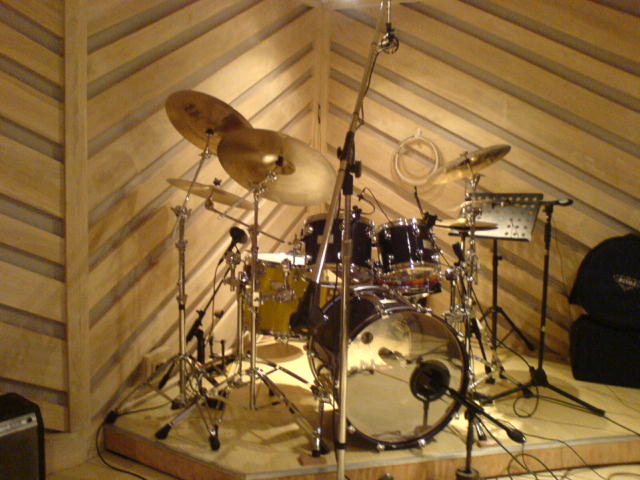 For that session, I set up the Mapex house kit with 3 toms (10"-12"-14"). My cymbals were a mix of Zildjians, Sabians & Paistes. My ride cymbal was a 22" Sabian Neil Peart Paragon Ride, which sounded big yet crisp. My effects cymbals were a Paiste Twenty splash & China, which sounded well on the mix. The hats and the crashes were all Zildjian. I also used my Old Faithful 14" Tama Starclassic Maple snare drum. No disrespect meant to Studio H's snare drum collection, but I thought of using my own drum so that I can hear how it sounds on recording. And finally, I hooked in my DW 5000 double bass pedal, which I got to use on a few fills & some straight-ahead passages.
I hope to have another opportunity to work again at Studio H. I had a blast.
Subscribe to:
Posts (Atom)